

The Mums.
The Joy of Being Mothered by Other People's Mothers.

Years ago, when David and I first fell in love, we cooked dinner together for his work friends and colleagues, and his brother and sister-in-law. He invited everyone over to our NYC studio apartment on 100th street, where David had quickly moved in without either of us really talking about it. Everything had been heating up quickly, the relationship was forming around us without us driving it. And this dinner was about meeting his people. Getting everyone around us up to speed.
I was nervous, of course, and wanted to make a good impression. I’m not entirely sure what we made for supper. But I remember we shucked oysters, and I remember being pissed at myself for convincing my fishmonger that it was just fine for me to handle the cleaning and shucking myself. Rookie mistake.
But the dinner went well enough and no one had to swallow sand from their oysters. We ate, laughed. I enjoyed their funny stories about David. They were all mostly Australians, like David, so I was soaking up all the jokes and the accents and the cultural differences. I cleared some supper dishes and popped into the kitchen to check on my pavlova.
Now, for those of you not familiar, pavlovas are iconic Australian desserts. Pavs have a meringue base made from whipped egg whites, sugar, a stabilizer like cornstarch or cream of tartar or an acid, like vinegar or lemon. The meringue is baked in a very low (and accurate) oven, convection (or fan-forced) ovens do best. What comes out (hopefully) is this glorious white mound, delicate and crispy on the outside and marshmallow-creamy inside.
When the pav cools, you can pile it up with fresh whipped cream, berries or stone fruits (passion fruit and lemon curds are my fav) and then, a topper, a little lemon zest for kick, or a few herb leaves like mint or thyme, maybe a handful of edible flowers like pansies or lavender to make it pretty, nuts like pistachios or hazelnuts for crunch, or even a rain of powdery confectioners sugar over the top.
This dish can be a fucking show stopper, and this is what I was going for.
I was also a newbie at entertaining, but paging through English cookbook author, Nigella Lawson’s 2001 baking cookbook, How to Be a Domestic Goddess, I had laying around, I found her Chocolate Raspberry Pavlova.
Her head notes read like porn, all sensual and horny:
You just cannot beat a pav in my book, and I glory in particular this dark beauty. The crisp and chewy chocolate meringue base, rich in cocoa and beaded nuggets of chopped plain chocolate, provides a sombre, almost purple-brown layer beneath the fat whiteness of the cream and matt, glowering crimson raspberries on top: it is a killer combination.
Nigella neglected to mention that the pav was an iconic Australian dessert, right up there with lamingtons, vanilla slices and anzac biscuits. I was clueless. Oblivious. Total newb. This meant that I was serving my guests something they had probably eaten tons of times, had grown up eating them in their moms kitchens, and had ingrained cultural memories of how they should look and taste like.
Nigella also didn’t mention in her horny head notes that pavs are persnickety little fuckers, and getting that meringue to grow into this majestic fat round with the perfect exterior and interior textures can be tricky, particularly for baking and entertaining novices like me.
After dinner, I cleared supper dishes, and headed into the kitchen to ready dessert. I had my cream and raspberries ready to go, and the little bits of dark chocolate I wanted to rain all over the top.
But the pav itself was a small crisis.
It had fallen. Flat as a pancake. Instead of this proud, stand-up-straight lofty meringue, what I found was a dark brown gooey mess that had fallen onto itself into a muddy brick.
Fine. Fine. I’m nothing if not adaptable. I quickly re-grouped and resolved to call it a fudge brownie, pile it with cream, berries and throw some chocolate shards over the top, and get on with things. No one had to know. It could stay a cook’s secret. What happens in the kitchen stays in the kitchen, or some such thing.
But David and I were a new couple. We didn’t have the secret codes and signals that couples have when they’ve been together for years. Before I could stop him and fill him on my fudge brownie story, I heard him yell to the others: Kim made a pavlova for everyone! Come in and check it out! I heard people moving around. Fuck! Fuck! Fuck! My new friends and family, the people I wanted to impress, gathered excitedly around my sad little flat pav.
Hmmmm, that’s not quite a pav, someone else chimed in from behind my left shoulder.
I wonder what happened?
Oh they can be so tricky…
I was crushed. Embarrassed. I didn’t have the cooking experience I would come to have later, after decades, where a misstep could be doctored or re-assembled into something else in the secrecy of the kitchen. Or that I could just come right out and admit the truth, laugh it off and make light of it. Well, I guess I fucked up dessert! Onwards!
But I wasn’t there yet in my cooking journey, or my life journey, or my relationship journey. I hadn’t quite settled into the more confident parts of myself. This would come with age and experience and maturity. But not yet. Instead, it felt like a grand humiliation.
But then…
Hey! someone chirped up. My mom makes a great Pav, let me call her!
It was midnight in NYC, but all across Australia it was the afternoon in Sydney, Noosa, Brisbane, Melbourne and Cairns. And one at a time, our guests called their mothers, who, over crackly 2004-ish era flip phone loud speakers, told us about cream of tartar, which overwhlemingly all the Aussie mothers used for their pavs, and had deep consequential theories about its necessity. Nigella’s recipe conspicuously omitted it, and this was clearly a cultural abomination. They suggested I use Donna Hay’s recipes instead. This was my first introduction to Australia’s very own Martha Stewart.
There were also deep discussions of the un-eveness of the heat in my rental’s oven, and the lack of fan-forced heat (convection). The moms gave us lessons about humidity, dryess, and perfect pav-making climates and seasons. The need for a very low oven heat setting that probably wasn’t even possible on my rental stove. I was told that when the pavlova sinks, like mine did, it’s called weeping. This felt apt.
They asked me whether I had used the super fine caster sugar (I did not) as this would help set up the structure of the merengue, and stabilize the egg whites. And then they instructed me not use too much cream of tartar, lest it take on a metallic taste. (Noted) Some of the moms heated their egg whites and superfine caster sugar in a bain-marie (double boiler) to dissolve the sugar before whipping.
Were the egg whites room temp? one of the moms asked, and sounded relieved that they were.
The mums, Aussie for moms, thought the idea of a “chocolate” pav was on a spectrum of somewhere between ridiculous to offensive. They stripped Nigella’s poor recipe down to its clean white bones. In a series of phone calls, the mums had managed to convince, not only me, but the room full of their children, that none of this was my fault, and that I had been undone by an English recipe writer who really didn’t know her ass from her pavlova. (Sorry Nigella, we still love your horny prose!)
That was how I met both David’s mum, Ann, in Sydney, and Trish, the wife of his father, John, in Noosa, on the sunshine coast. Along with the mums of friends and colleagues that I would come to sit next to at David’s shows, and on visits to Australia. It was memorable and warm. The perfect way to meet the women who would make up our extended family, and love on our kids, and women who I would come to love and appreciate for the way they extended themselves to me and invited me into their world.
Last week, we lost one of the last of these mums. Trish was 91. David’s dad’s wife. She lived a full beautiful life, with the full spectrum of experiences both wonderful and hard. She died loved, considered, and not alone. David will be there next week to be with his dad as they throw her ashes into the rivers around Noosa.
Losing these mums, one by one, over the years, some I know and loved well, and others I spent time with and have memories, others only that night on the phone, I’m presented with how much I appreciated them mothering me that night. I also think about how many of us younger women at the party are now mothers, and how we are doling out our own advice, counsel and support to our grown, and nearly grown kids, and their friends. I’m aware of the constant churn of the clock, the steady thrum of change in our lives, how we matter to people in the most minute, but still tangential ways, simply by mothering the people around us.
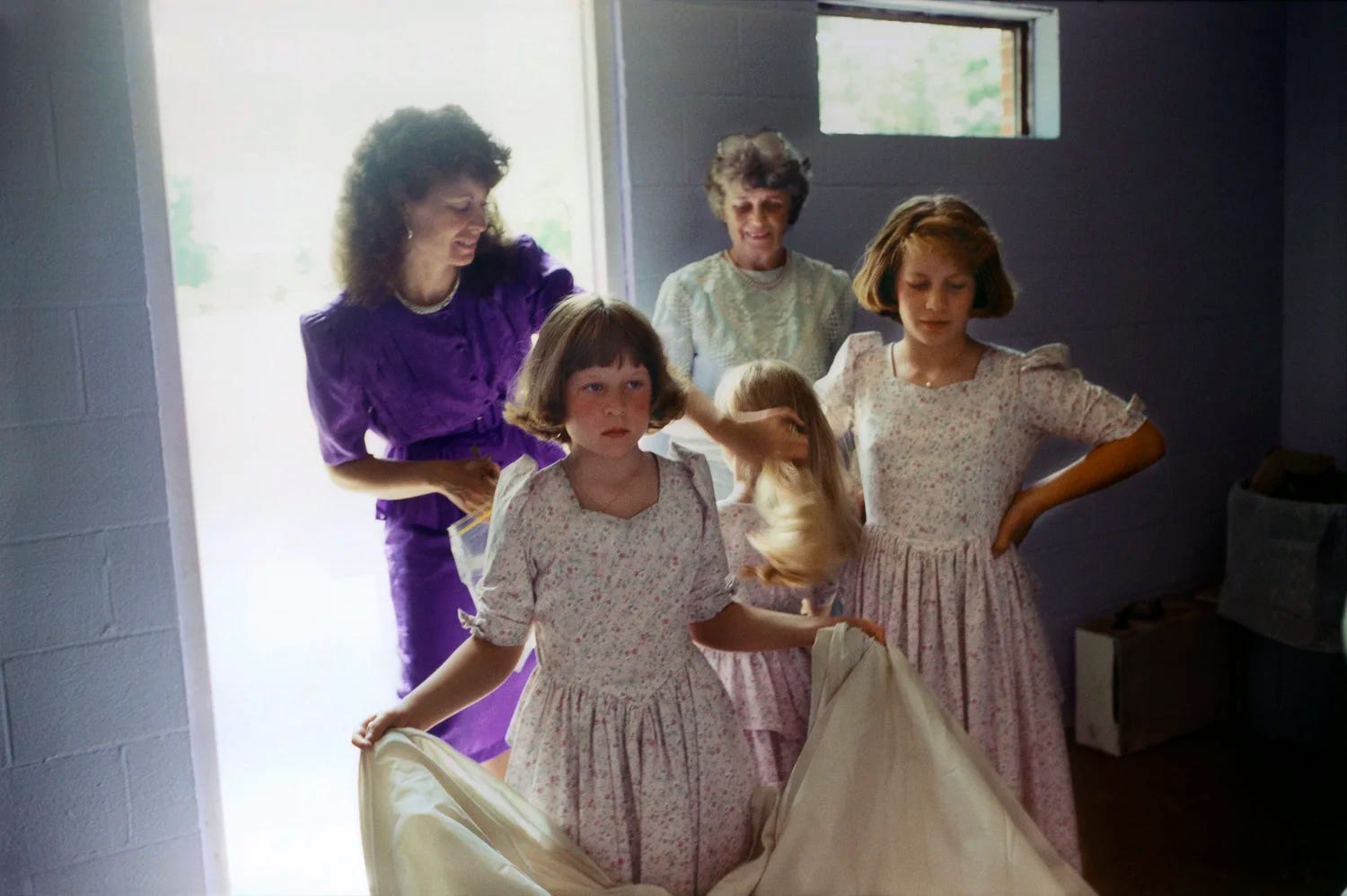
Sometimes the mother-child relationship can be difficult, complex, weighted down by old disgreements, disappointments, wounds, and failures. That relationship is primal, even when it isn’t good or good enough. Being estranged from your mother, for instance, is its own relationship. The absence never stops having an ache, and the ache, like it or not, the absence of her, becomes your mother.
And this is because mothers and their babies are all mixed up in each other. Mothers who’ve given birth have their baby’s fetal cells in their organs, skin and brain. We carry the cells of our babies around with us our whole lives. As toddlers, they are all over us, feet in faces, our heaving breasts feeding them, our warm chests and stomachs providing safety and comfort, legs sleeping intertwined with little, sharp-kneed, ever-moving appendages. They cling to us and feel its necessary to sit on our laps while we poop, because they cannot stand the idea of being untethered to us.
Later, they will thwart that closeness and leave, and we will cling to their fetal cells and photo albums, and wonder how it all went by so fast. Then, they come to us as adults, with their own ideas, beliefs and ways of being, and we try to love them right where they are, while remembering not to smother them with our love, the way they smothered us wih theirs. It’s so intertwined and ropey and intense. The mother-child relationship can always go off-the-road, or it can become the balm the family needs, and both of these happen, over and over, until we fucking die.
But the mums who mother us tangentially come without baggage. Without intensity and past hurts. They can meet us where we are, can more easily forgive us the history that got us here, and we can laugh when they are irritating or maddening, because we do not carry each others cells, we do not have the intensity, the history, there is no obligation. They are not mandated to be in our lives, or to even expose their greatest intimacies, or learn ours. They just show up and give what they can in the moment, and sometimes it’s so simple as to be profound.
My mother-in-law, Ann, loved for me to cook for her when we visited her in Sydney, even as my own mother critiqued my cooking. Ann’s appreciation mattered to me, deeply. When my body was unruly and recovering from back-to-back pregancies, my other mother-in-law, Trish became my personal shopper, taking me to boutiques and pulling clothes off racks that might make me feel beautiful again. This mattered to me, even as my own mother critiqued me for letting my body go. Trish reminded me of my beauty, when I thought it had disappeared forever.
The mums who are near us, but not mixed up in the debris of our living, are a salve. And they represent opportunities for mums embroiled in complicated relationships with their own children, to still be essential to other people’s children in the world, to still be able to mother. To save an evening, remind us to be ourselves, to love us right where we are, to guide us with oven temps and lessons on humidity, to step in when our own mothers are not able. They offer us something uncompromising and simple.
I hope that my adult daughters, out in the world, are able to find their mums, to fill in the gaps that I’ve evitably left, if not by fault then by distance. And to then return that favor decades from now, as mums and aunties to other people’s children, if they choose to. (Cue The Circle of Life from The Lion King.)
The mums remind us of the village. That we are not alone. That mothers and mothering can be found everywhere, in different doses and prescriptions, and that to be mothered at all is one of the great gifts of the universe.
Thank you, as always for reading. Kim xo

Thanks. I miss my "mums,' though I called them extra moms. They held me when my mom was being . . unreasonable. One told me she'd teach me Italian, starting with one phrase until I had it perfect. I should have figured it out right away but as I couldn't have said it in English I did not recognize it: Io sona bella. I am beautiful.
I was fortunate to have extra dads too, my parents' gay friends. They also held me when my mom was being . . unreasonable, though while hugging me they'd murmur, "she's such a bitch."
Sorry one of your loves is no longer there for hugs. I still feel held by mine, seventeen years after I lost the last of them.
"Sometimes the mother-child relationship can be difficult, complex, weighted down by old disagreements, disappointments, wounds, and failures. That relationship is primal, even when it isn’t good or good enough. Being estranged from your mother, for instance, is its own relationship. The absence never stops having an ache, and the ache, like it or not, the absence of her, becomes your mother." Oof! Beautiful writing that nails the emotion and experience.
Let's re-parent ourselves, become our own secure attachment, and forgive everyone for not having the unrealistic, ideal mother-child relationships. Thank you, Kim!