

Ghosted.
On Sudden Disappearance and the Mourning After.

Back in May, I applied for a lecturer position at a local university. I had taught before, in grad school, and at Pace University in NYC, and I loved it, the students, their ideas, their refreshing views, the relationships formed and nurtured. I stopped teaching when I realized the cost of hiring a babysitter for two kids under two would cost more than what I could make at the university. Ghostwriting books was more lucrative, and I could write them from home with part-time help. I don’t regret the move out of academia, there is a season for everything, but I figured I’d return someday.
A position opened up and it fit my skills, experience and education pretty perfectly. I could see myself sliding back into academia. The job was teaching what I do in real life, interviewing and writing about people who are often unseen and invisible, and helping students untangle stubborn systemic issues and write about real people navigating them. This is what The Meth Lunches was about, and I’m proud of what that book did for readers. The idea of young people wanting to do that too was exciting. I showed up for a Zoom interview, the first step.
Las Vegas is the kind of city that is big (there are a couple million of us) and small (everyone knows everyone and everyone hears everything) so it wasn’t a surprise that I knew one of the search committee folks socially. I also knew my competition for the job. The other candidate had asked me to come to his class and teach writing in one of his seminars, which I did. He had been teaching as a visiting prof in the department, and I’m sure, was eager to slide into a more permanent position, which was the one we were both vying for.
I knew I’d be great in the role, but I also understood that my competition had been there for a couple years, had taught various classes, and seemed to be a solid educator. He, surely, had close working and social relationships with the search committee, and they would be keen to promote him. I was positive, but also realistic. The goal I set for myself was to meet new people, perhaps make a good enough connection with the faculty to be considered for another teaching position, or maybe I’d just get super lucky and get this one. I had ideas, collaborations, and partnerships between students and people in the community lining up in my head. I stayed open.
I was invited for an on-campus interview the following week, an excellent sign. I was told the process would last all day. I was given general parameters for what was needed. I would meet a bunch of people in the department, get a tour, and have lunch with staff. I was asked to put together an hour-long presentation defining the subject and how it could be taught in a classroom, and then another hour-long teaching presentation where I was to show off my teaching skills to a room full of professors in a mock class.
I don’t like the idea of doing free work for an interview. But they weren’t asking for anything proprietary and I felt this could be a worthwhile experience. I went all in. I stopped working on the research for my next book for 10 days, and neglected to write an essay here. I spent less time with my family. David set aside his work to support me. I did the interviews and presentations on the day. The people were very nice. They bought me tacos for lunch. These were competent, thoughtful people. I was told the decision would be “quick.” I sent a thank you note. I got a ”It was great to meet you” message back and then….
Crickets.
It is now August 6th. The last interview happened on June 3rd. I sent a follow-up email on July 13. I didn’t even get a bone-dry form letter drafted by the university application portal. Ghosted.

I’m not going to get into the full mechanics of academic life (borrrrring) but ghosting candidates turns out to be a common hiring practice these days for academic departments and corporations. I’ve been told there are reasons for this.
Sometimes there are too many candidates to respond to all the folks interviewing. The job market is overflowing with more candidates than jobs. Big institutions can get hundreds of candidates clamoring for a single position. And budget cuts have led institutions and corporations to increase workloads while cutting back on the number of administrative jobs, essentially the people who may have handled communications with candidates.
Dr. Karen Kelsky, author of the widely-read The Professor Is In: The Guide to All Things PhD blog, connects how and when people are treated as valuable and how that treatment is directly correlated to economics. Morals are a by-product of economics, Kelsky writes, because accountable hiring systems require money, money in the form of administrative staff, and reasonable work demands.
Add to this, HR departments often don’t trust faculty/employees to have human conversations that, if handled badly, could lead to litigation. HR also tries to keep their second choice candidate “on ice” so if the negotiations with their first choice falls apart, they can still cover the position. This process can take months.
All of these explanations for ghosting candidates seem reasonable on the surface. And yet, the ick remains. As one academic said in an interview about being ghosted: Am I so valueless they can’t even be bothered to tell me to go away?
Alicia Andrzejewski had a similar experience and wrote this in her powerful essay The Sad Humiliation of Academic Ghosting for The Chronicle of Higher Education:
Then, abruptly, without explanation, my colleague ceased all communication — as if dead. A literal ghost, they became impossible to trace, but they remained a persistent presence in my thoughts. It’s strange, being haunted like this in a professional context. It feels more intimate than it should.
And that feeling, according to research, isn’t fleeting. Philip Roth, Distinguished Professor at Clemson University, recently published a paper where he examined what happens when employers, without explanation, stop communicating with candidates after in-person interviews. The findings, he said, were “startling”: The reactions from ghosted candidates weren’t mild or temporary. Roth found that ghosting produces powerful and lasting anger-based emotional reactions that can damage an organization’s reputation and future hiring efforts.
Roth calls delivering news to candidates even when it’s disappointing, a form of informational justice and that when these notifications are made, they improve the image of the institution, and the applicant’s willingness to re-apply. Alicia Andrzejewski continues:
I spoke to dozens of academics, from graduate students to department chairs, who described feeling… the “triumvirate of Ds”: “discarded, defeated, disposable.” An assistant professor in Germany observed, after several colleagues who accepted her invitation to edit a special issue of a scientific journal disappeared, “I can’t help but think that they would never have ghosted a senior (male) academic from the Ivy League.” For many, being ghosted resulted in enhanced feelings of isolation in an already isolating profession.

Ghosting is cultural and political and personal. It’s also who we are now. The act itself belies who we value, and who we don’t.
The ghosting happens to all of us, in employment, dating, love, platonic friendships, family members, and we perpetrate as well as are perpetrated against. Even the new trends toward family estrangement, where children purposefully cut off their parents and extended family, is a form of ghosting. As is the particularly horrifying trend of therapists abandoning their patients without discussion, something that seems particularly cruel and against the very tenants of therapy. We are people who no longer feel accountable to people we perceive as being outside of our bubbles.
Humans have been trying to get out of uncomfortable social situations with each other since the beginning of time - this isn’t new. This is why going out for a pack of cigarettes and never coming back is such a well-trodden metaphor for abrupt abandonment. But pre-internet, we expected friction. We knew the break up conversations would be hard. We knew firing someone face-to-face would be uncomfortable, maybe even traumatic. We had to face these realities because we didn’t have text, Discord, email, or Instagram DMs to act as subterfuge. We couldn’t disappear, because the person we wanted distance from would most certainly be at volleyball practice, or church, or the factory the next day. Every interaction had to be personal, by design.
Now, we are a tap away from virually everyone. This started out as something profoundly revolutionary, the idea of being inter-connected with people in other countries, other cities, with other experiences. There was this time on the internet, the blogging of the aughts, the early days of Twitter, where the connections we made were so exceptional, the whole experience was heady and thrilling. It felt like the world had opened up for us, introducing us to people we could never have accessed in our everyday lives. Many of those relationships became real-life relationships and endured over decades. People collaborated in physical spaces with people they met in online ones. It wasn’t perfect, but the internet felt like it could be connective tissue, bringing us closer together from all pockets of the earth.
But we are post-connection now. On dating apps we are commodities, the sum of our two-dimensional profiles and stats. In job searches, we are herds of cattle to be picked through, utilized or discarded. On social media, we perform a thin version of ourselves and create equally thin versions of the people we interact with. We hide behind our devices. We hide behind our thin opinions and theories, instead of universally-accepted morals and truths. We hide behind our sensitivities and vulnerabilities to “feel safe” and we use “self-care” and “wellness” to buffer ourselves from all kinds of life’s frictions. We perform the thin versions of ourselves even as we ache for authenticity. People consume us, we consume other people. When we are done, we ghost. Because all of it is thin.
But the ghosting never really makes people, or our problems, go away. The souls of the ghosted linger. They are in our feeds, our comment threads, our platforms. Australian author Dominic Pettman likens this to a chalk outline at a murder scene, a kind of forced creation of empty space, a constant reminder that something tragic happened. We live with these chalk outlines of lost connections all the time in a way that enhances our loneliness. We are constantly reminded of not being chosen. It is easier now to throw people away.
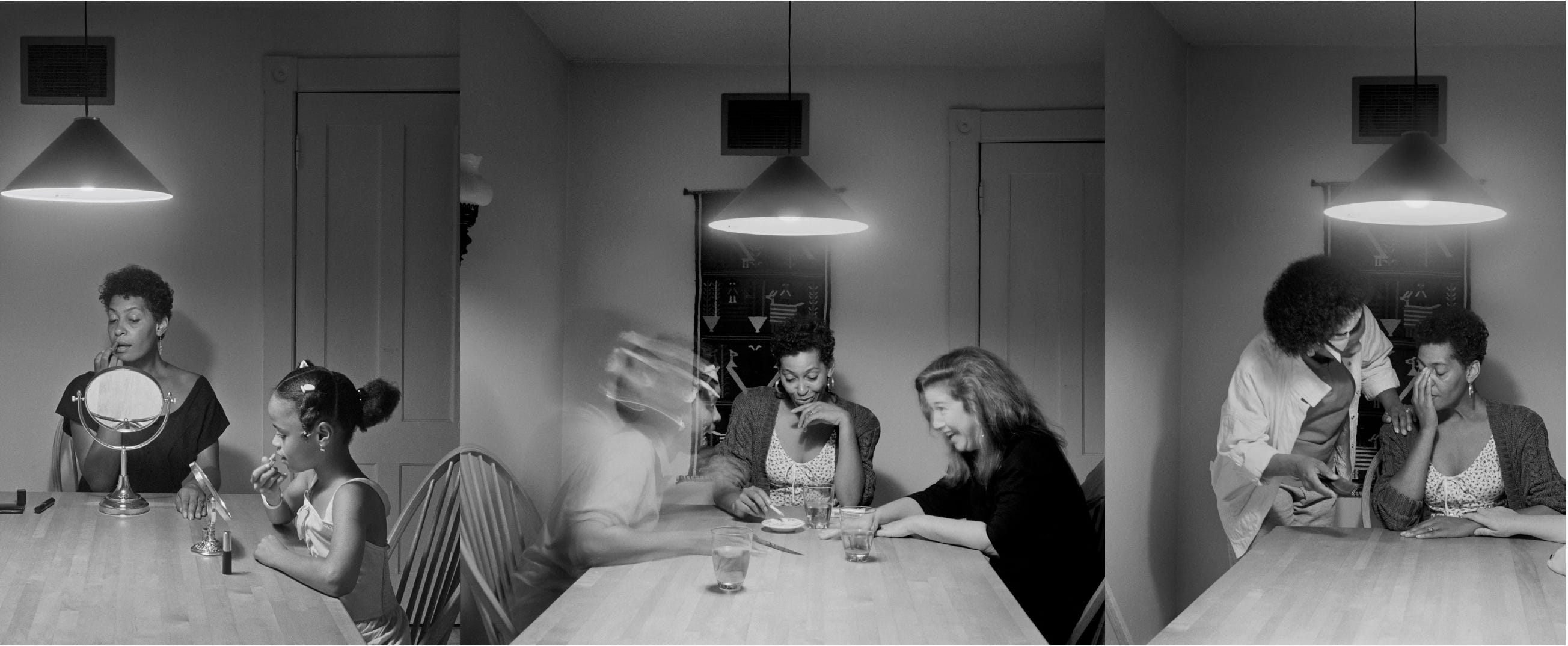
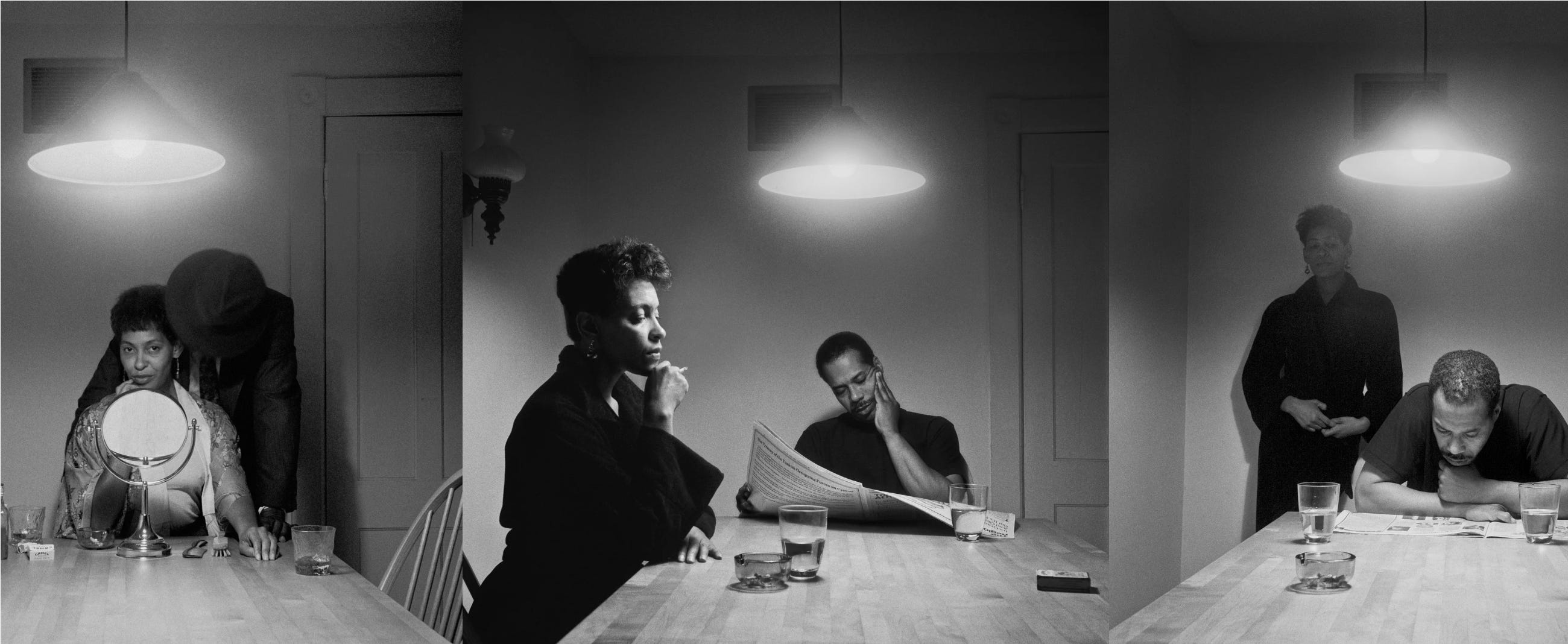
We are, more and more, locked into apps, platforms, inboxes, where intimacy and emotional literacy are not useful tools. Our institutions, it seems, have followed suit. I chose the work of Carrie Mae Weems, to accompany this essay, because of the intimacy in her photography. The smallness, the ubiquitousness, the quotidian nature of these small human interactions at the kitchen table are the acts that make a whole life. They feel like the perfect medicine for our collective loneliness and our disconnections from each other.
Today is the last day I’ll check my university application status, even though it is still open as if I’m still being considered. I could email the search committee this, but I’ve been told that to vanish without consequence is to claim the last word without speaking.
I guess I get the last word.
Thank you, as always for reading and supporting. xo Kim

Sadly, getting ghosted after an interview is the daily reality of the acting profession. Right after your very first audition, you learn to *expect* never to hear anything back, ever ever (and thus are surprised if and when you do)!
It's such an odd thing to me, for this profession that is absolutely predicated on sensitivity and vulnerability! Actors are constantly told they must get "thicker skin," as though that isn't antithetical to the very nature of doing beautiful work as a performer!
And somehow this is completely acceptable - even in the very final stages of casting, when you have had callbacks, sometimes several callbacks. You may only get confirmation that you didn't get the role because you know someone else who got it, or because it is past the date when they stated rehearsals would begin!
My sense is: If you are a second string backup for any position, it is perfectly right and courteous that you be informed of that!
"Hey, we wanted you to know that we liked you for this (position, part, team, etc.) very much. We gave the position to someone else, but if it doesn't work out, we would really like to offer it to you in the future. Would you be open to that?"
This doesn't seem to be something that takes too much effort to do, particularly after a job candidate has put in a considerable amount of time and effort (such as your day-long interview and mock class)! Just seems like basic human decency to me?
I'm guessing someone in that hiring committee will either hear about or read this essay, and you'll be hearing from them, don't you imagine? It is a very small community that way. It's super weird that they left you hanging after the whole day-long in-person interview / presentation. Just very odd. Sorry that happened to you!