

Pyramids + Other Shapes.
What Our Food Guidelines say about Us.

FRONT END NOTE: David and I do not often fight, like get pissed and refuse to speak to each other. But last week we got into a doozie over the new food guidelines inverted pyramid. LOL. Yeah, ridiculous. So I felt compelled to write about them.
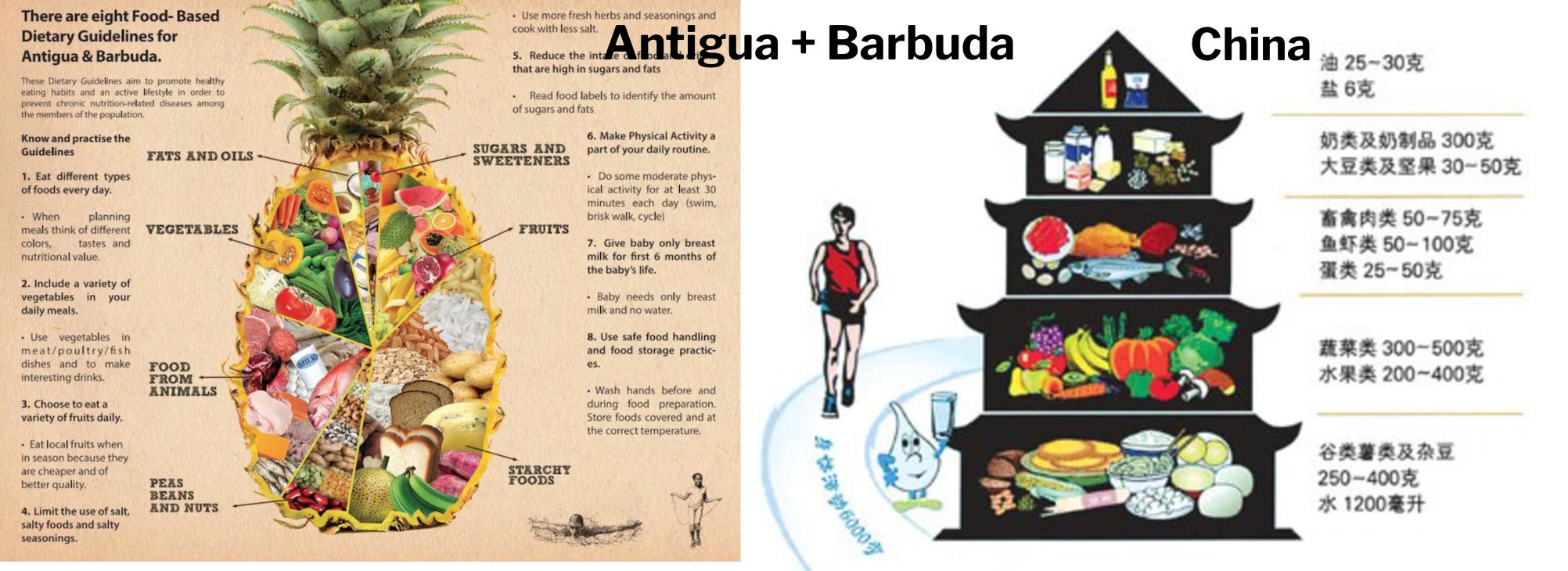
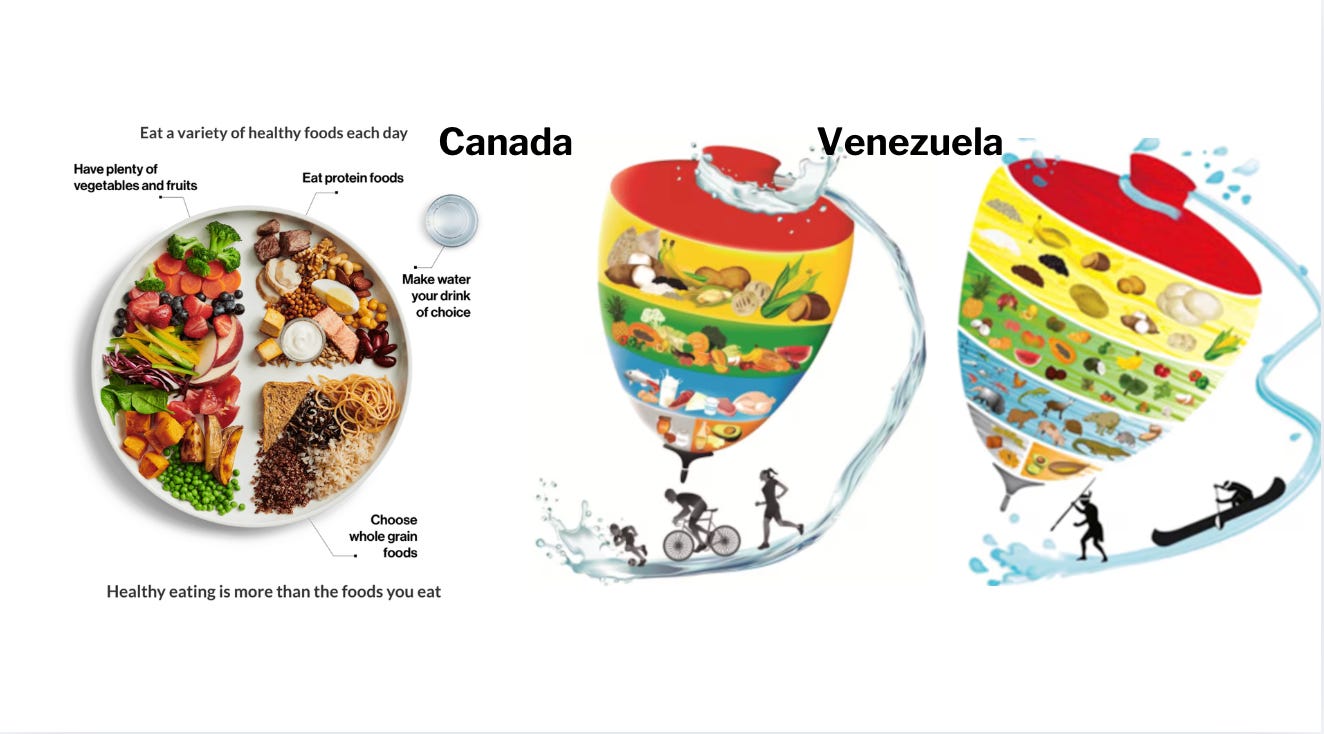
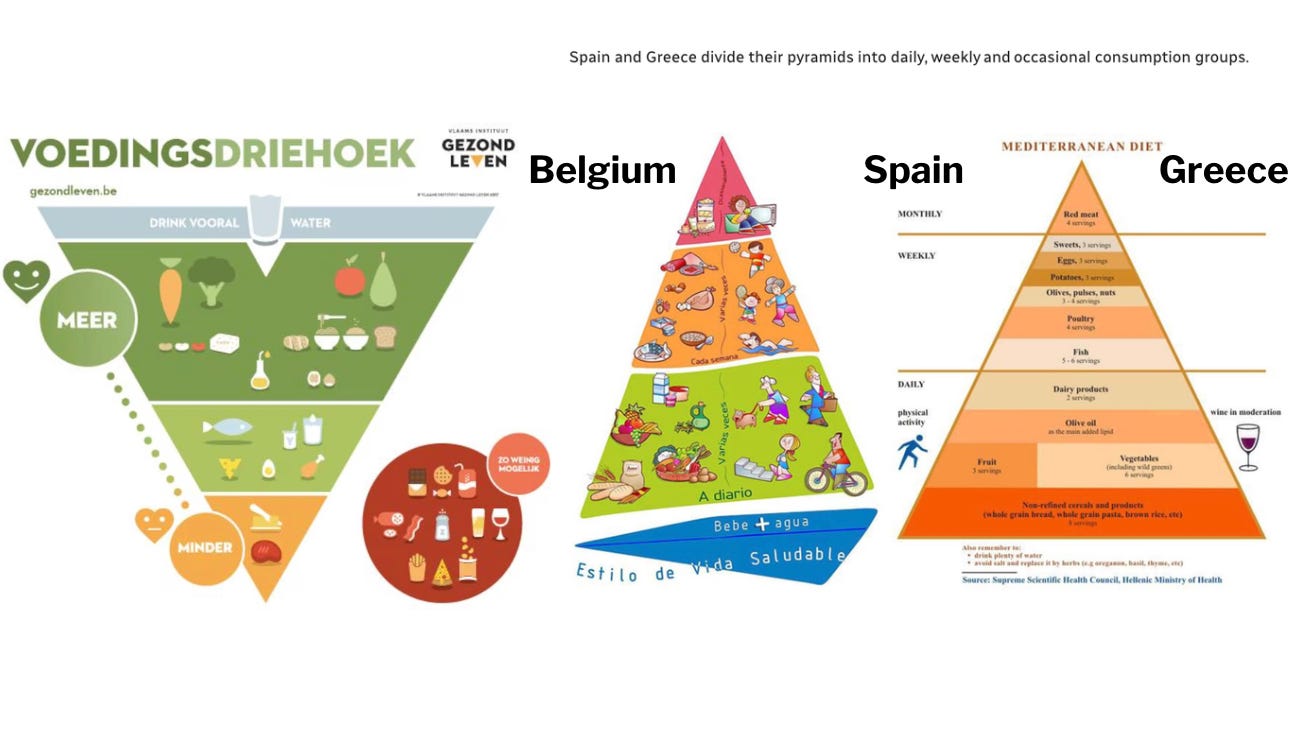
During the writing this week, I got a little obsessed looking at different country’s food guidelines, the shapes they choose for the diagram, the colors and patterns, what they include or leave out, what the guidelines say about our culture and our eating. Fascinating.
Feel free to disagree with anything here, but you know, let’s not stop speaking to each other. LOL. (David and I are fine now obvs.) Also, behold the slides I made in Canva of food guides from around the world. They are pretty amateur, but they led me down a fun rabbit hole.
Thank you, as always, for reading. xo Kim
___________________
Ultra-Processed Foods.
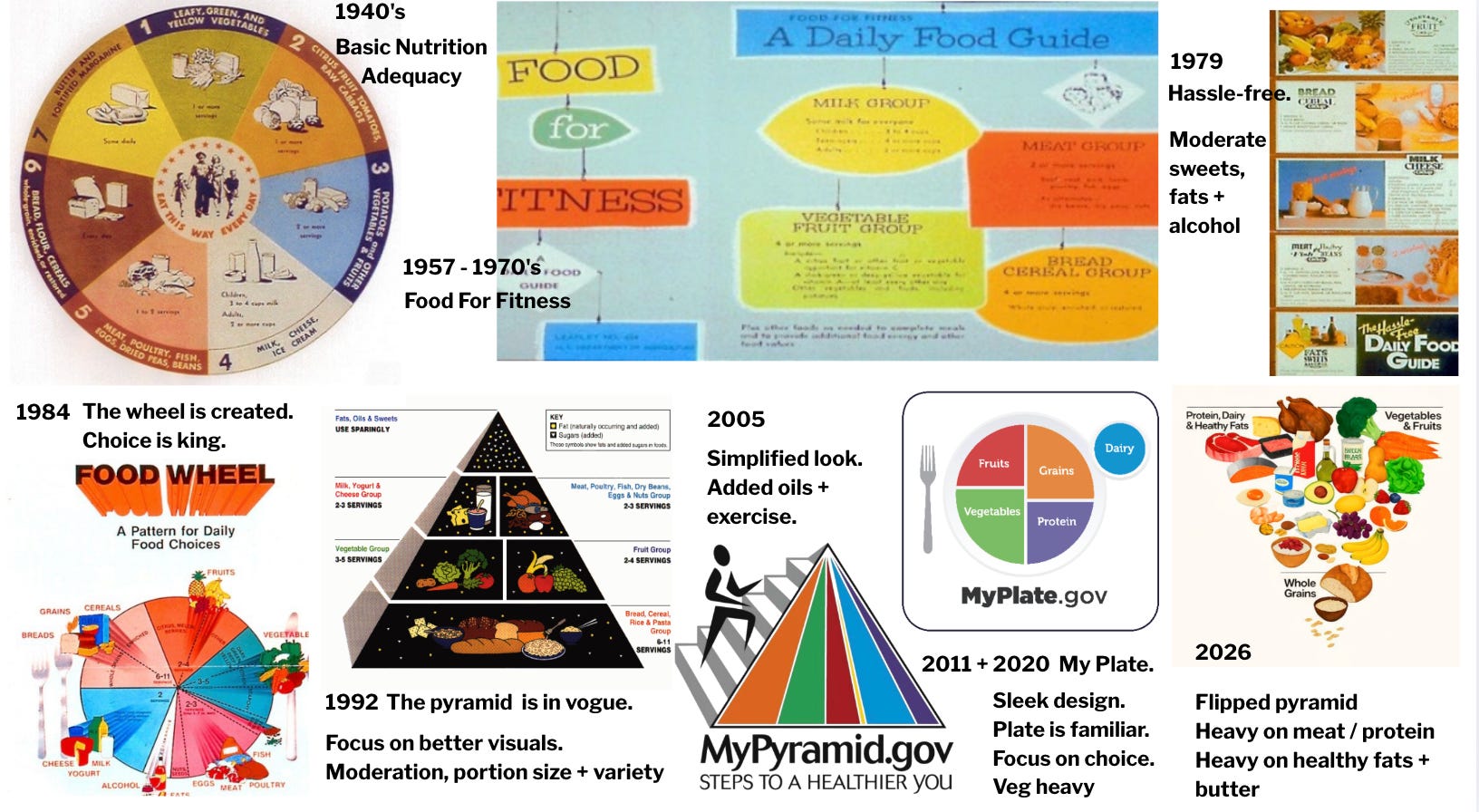
The first week in January, RFK, HHS and the USDA, introduced a new food guidelines chart that significantly changes how the government wants us to eat. One of the strengths of the new chart is that it recommends eliminating "highly processed packaged, prepared, ready-to-eat, or other foods that are salty or sweet…including “sugar-sweetened beverages.”
Great start.
Unlike yogurt, pickles, canned tuna, and cheese, which are “processed” foods, because some preparation is required to to turn ingredients into these food products, UPFs are different. They are loaded with industrial chemicals, like emulsifiers, artificial colors, high-fructose corn syrup, hydrogenated oils, flavor enhancers, and preservatives.
Pretty much all the research on ultra-processed foods (UPFs) comes to the same conclusion: UPFs contribute to chronic cardiovascular illness, like heart disease, stroke, Type 2 diabetes, obesity, depression and anxiety, cancers of the colon and breast, and shortened lives, both in quality and expectancy. UPFs have played a pivotal role in our diet, because they are cheap, mass produced, widely available, require little human effort to make, can be eaten with minimal cooking tools, and are mostly shelf-stable. They are given out in schools, churches, community events and food banks, school district cafeterias, jails, purchased in every supermarket, dollar store and gas station. UPFs hook consumers in with chemicals designed to make human bodies crave more (think cigarettes + nictoine). Add elite, celebrity-driven, marketing machines, 24-7 internet access, targeted algorithms, peer pressure, and brands can quickly feel like a trusted friend. They set the taste preferences of children in the crib.
So how did we get so much food with chemicals?
The FDA over the past few decades has been lax. The agency has a vague designation for some foods, known as Generally Recognized as Safe (GRAS). The FDA has let Big Food companies (Nestlé, Pepsi, Coke, Kraft-Heinz, Post, Unilever, etc.) slide products through under this designation. Big Food loves this. It allows them to add chemicals without approvals from anyone in the government.
When there is oversight by congress or the FDA, these food companies have powerful lobbies to block and postpone regulations and legislation. The National Institutes of Health (NIH) have compared Big Food to Big Tobacco specifically, because they use similar fraudulent tactics to bypass the health and well-being of citizens. This includes funding compromised/false science, creating and adding addictive chemicals to trap users, and purposefully flooding food banks and schools with shitty foods to target kids and poor people.
Our government further contributes to the proliferation of shitty food, by providing subsidies to farmers to produce monocrops of corn, soy, wheat, and rice, instead of actual vegetables and human-edible crops. Because these products are subsidized by the government, they are good for the farmer (the government is paying them, essentially, to farm. This is an entitlement, like SNAP). And good for Big Food companies, who buy the corn, rice, soy and wheat and turn it into high-fructose corn syrup, modified starches, and refined flours. These become the building blocks for their processed snacks, sodas, and prepared meals.
We can blame regular folks for choosing UPFs when they shop at the grocery store, but most of us are unaware the corporate forces around shaping our diets. How much choice do we really have? For RFKs food guidelines to make any difference at all, he will have to take on Big Food in real and disrupting ways, that change our food system radically.
What would this even look like? Can RFK even execute a plan, if there was one? Details are not his strength….
Fermented Foods
Fermented foods have been added to the US food guidelines for the first time ever and reflect the globilization of our food knowledge.
Also a great start.
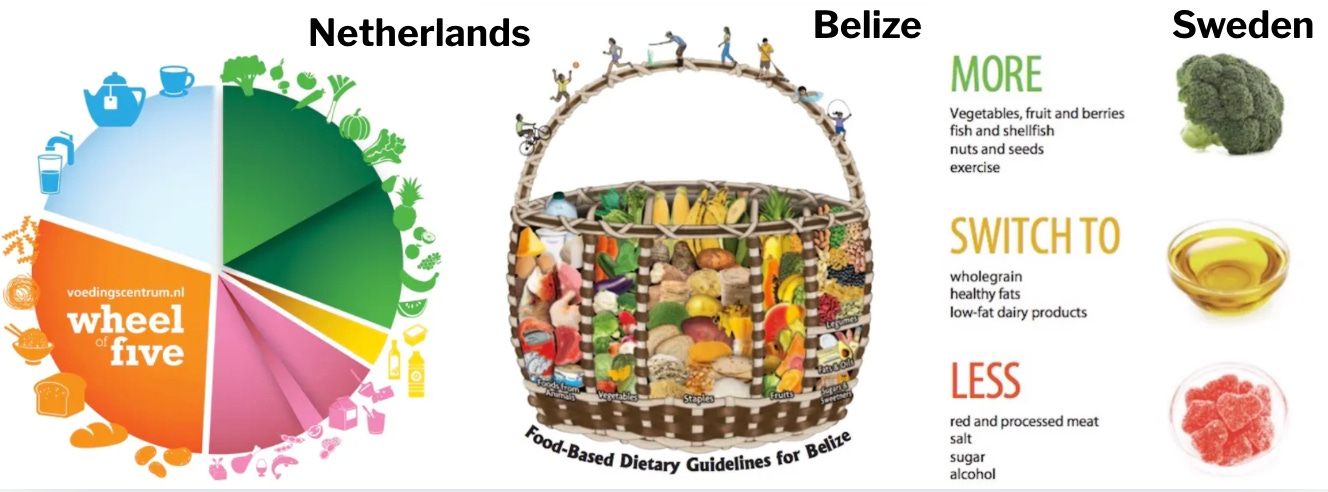
Fermented foods like kimchi, miso, sauerkraut, and crème fraîche, are now being lauded here for their digestive health benefits. Countries like Japan, France, Sweden and Korea have long understood the value of fermented foods for diversifying the gut biome. Better late than never.
Menopause.
There is no mention in the new food guidelines for people in peri/menopause. The text goes from “Recommendations: Lacating Women” to “Older Adults.” A miss.
Women have specific requirements for this stage. In their 40’s and older women require more protein to combat bone and muscle loss (25-30g per meal helps preserve muscle mass), plus Calcium/Vitamin D, Iron supplements, particularly for post-menopsausal women and their slowing metabolism, fiber for digestion support, and omega-3s to manage the symptoms of hormonal shifts.
To be fair, menopausal women have never been mentioned in US food guidelines, outside of the “older adults” category. Only the country of Lebanon specifcially addresses the needs of peri, menopausal and post-menopsausal women in theirs.
This is fascinating when you consider that, for the first time in the history of the US guidelines, RFK has included a whole section about how diet supports testosterone production in men. A whole section. The guidelines highlight diets rich in healthy fats, zinc, and Vitamin D for men, to support testosterone production. Women’s specific issues continue to be rendered invisible in health systems at home and across the globe, unless they are connected to birth.
Protein + Fats.
Ah, the Protein Wars. The number of Americans trying to get more protein into their diets, according to The New York Times, has jumped 13 percent since 2019. But not just any protein. New York Magazine just published: How Veganism Got Cooked: Plant-based Eating was Supposed to be the Future. When Meat came Roaring Back. And in 2025, Kim Severson wrote for The New York Times: Meat Is Back, on Plates and in Politics. Meat is hot again.
Some research is suggesting that a whopping 98 percent of households are buying meat now, and 73 percent consider it a healthy choice, up 10 percent since 2020. RFK has recommended that Americans eat up to twice as much protein as previously advised in our guidelines, a phemenon which specifically encourages eating animal-based proteins, leaning in on red meats (beef, pork, lamb, veal, goat, and venison), full-fat dairy (whole milk, whole yogurt, whole cheese), and animal fats in cooking (beef tallow, butter).
David had a heart attack in 2001, and since then, we’ve cut back significantly on red meat, because of its well-researched associations with cardio-vascular disease. This is partly what makes the inclusion of more animal-products so controversial with experts. Red meat has been found to TRIPLE a gut chemical known to compromise heart health.
The environmental implications of increasing our meat consumption are also alarming for the environment. RFK knows this because he wrote about it in a blurb for the 2005 book: The Meat You Eat: How Corporate Farming Has Endangered America’s Food Supply. Kennedy wrote:
The factory meat industry has polluted thousands of miles of America’s rivers, killed billions of fish, pushed tens of thousands of family farmers off their land, sickened and killed thousands of U.S. citizens, and treated millions of farm animals with unspeakable and unnecessary cruelty.
We know that consuming more meat as a nation will continue to devastate the environment, increase livestock feed lots and factory farms, create more underpaid and dangerous labor for meat industry workers, and require hundreds of millions of additional acres of agricultural land to support the increase.
Why the change of heart for RFK?
It’s probably worth mentioning that seven of the nine reviewers of the food guidelines are employed or have been employed by Big Meat (National Cattlemen’s Beef Association, Texas Beef Council, National Pork Board), Big Dairy (National Dairy Council, Global Dairy Platform, Dutch Dairy Association) and Big Food (General Mills, Danon). Marion Nestle, molecular biologist, nutritionist, and public health advocate out of New York University, sees this over-focus on protein, specifically animal proteins, as another marketing tool for Big Food to create more “protein-fortifed junk foods” rather than solve a health crisis for the population.
Looking at how the review board is stacked, it’s hard not to imagine this bias plays a significant role.
Milk + Masculinity.
Milk has been the subject of big discussions in science for the last two decades, at least, and different research tell us how complicated the issues are. RFK’s guidelines want us to sub in whole milk for the less fatty 2% and skim milks. The confusion comes in the details of the plan.
“The new dietary guidelines promote more foods that are high in saturated fat, Caitlin Dow, a senior nutrition scientist at the Center for Science in the Public Interest, told the Atlantic, “but they retain the old recommendation to limit daily saturated-fat intake.”
This means, if someone drank the recommended three daily servings of full-fat dairy, it would be “pretty close to impossible” according to Dow, to stay within the recommended limit.
What every expert seems to agree on is that milk, whole or otherwise, is probably not going to make or break someone’s health, disease trajectory or weight. What makes the discussions so critical is that the dairy industry is a $780 billion a year behemoth. When President Obama’s USDA required schools to offer low-fat milk, kids didn’t like it as much, and drank less. The dairy industry was incensed over lost market share. Trumps campaign and administration have received millions of dollars from the agri-dairy industry through conservative pacs.
Still, whole milk holds a very powerful nostalgia that fits into the MAGA movement and its desire to return to “simpler times.” The administration promoted memes of President Trump dressed as a 1950’s millk man, delivering glass bottles to our stoops every morning.
For MAGA, meat, full-fat dairy and cooking with tallow and meat fats represent the “full-on-ness” of masculinity. The same way the Department of Defense is now the Department of War. The way Hegseth wants to remove women from combat roles. Remove trans-women from service altogether. Target Black male soliders by going after grooming regulations that impact them alone. The way MAGA men wear their shirts too small to show off their biceps, representing a kind of “muscular leadership” and “warrior culture” where men need to be strong to combat the implied dangers in the world.
The idea is full-throttle masculinity, full throttle-whiteness, full-throttle nostalgia for things that never actually existed. Soy milk is fake milk, like fake news. Steaks are real, but protein sources like legumes, beans, tempeh, tofu, soybeans, nutritional yeast, and vegetables, like spinach, collards and broccoli, are feminist, hippy, leftist, and woke.
Real men have tiny shirts and big muscles, carry guns, and drink whole milk.
Design.
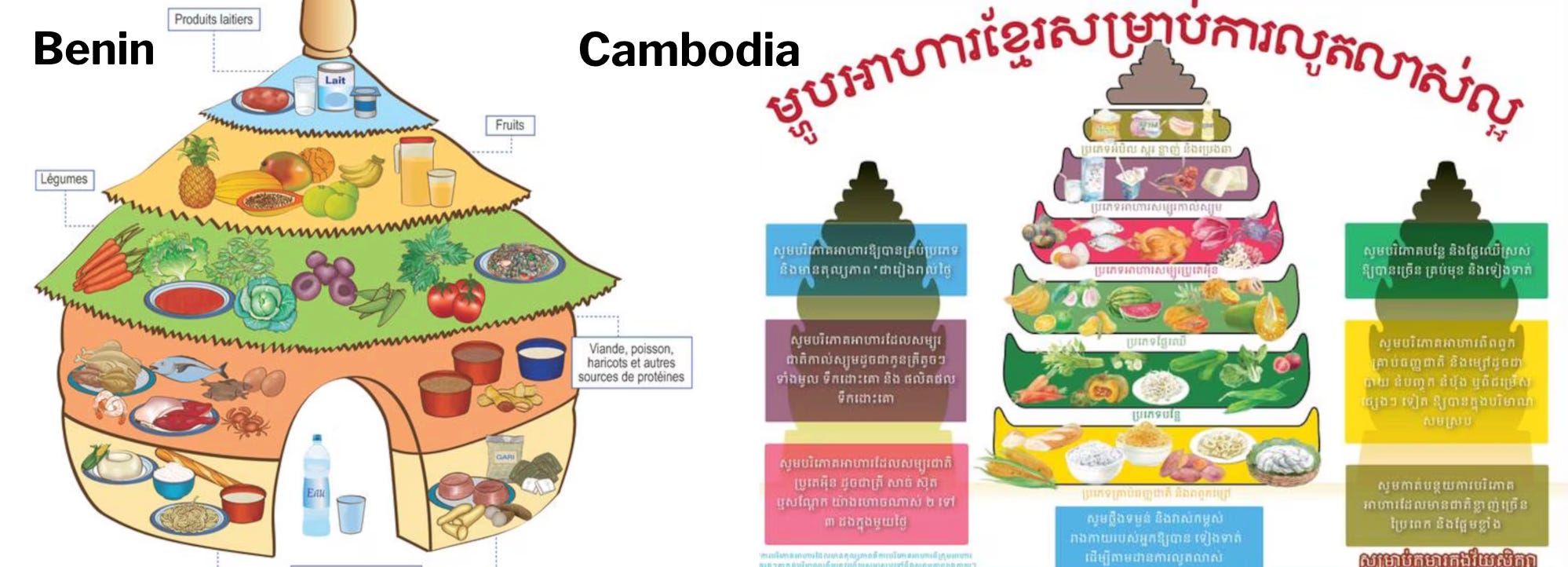
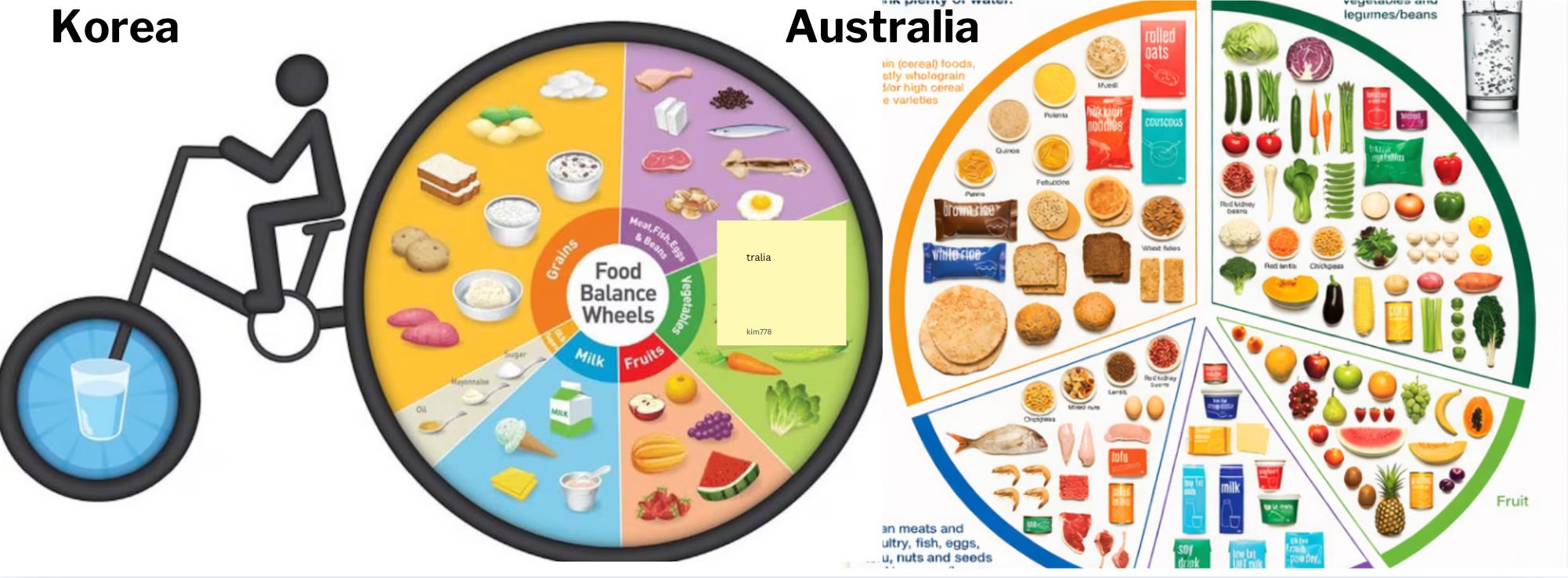
I loved looking at all the international guidelines. The shapes, the foods, the way each country cared (and didn’t care) to emphasize different components, how we view health and nutrition with such diversity.
The writer and designer Debbie Millman wrote her thoughts about the new US food guidelines design and said this:
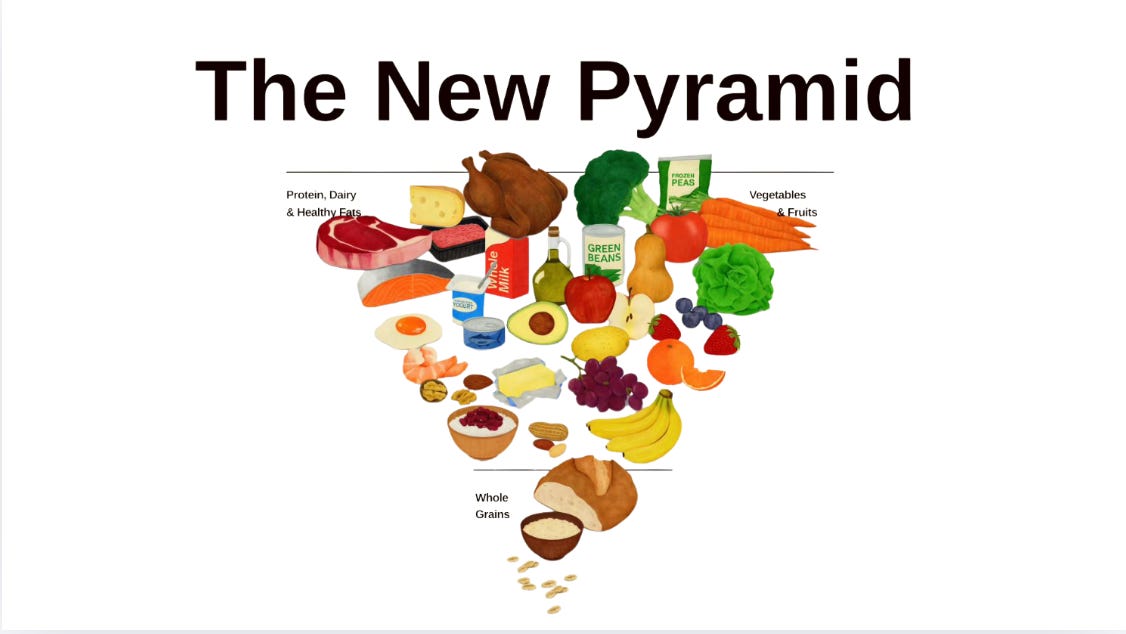
Where MyPlate (our last set of guidlelines under Obama) flattened hierarchy to emphasize balance, the pyramid reasserts hierarchy without adequate explanation, increasing cognitive load rather than reducing it.
Millman isn’t wrong. Without sections to visually mark off how much meat compared to veg, compared to starches, the new pyramid feels jumbled and not instructive. It asks questions and doesn’t answer them. The slogan might be “Eat Real Food” (Great, I love it.) but the point is to be able to look at the guidelines and understand how to eat better without reading the whole 90-page book.
RFK’s guide, unfortunately, is muddled and chaotic. Like the man.
Brazil.
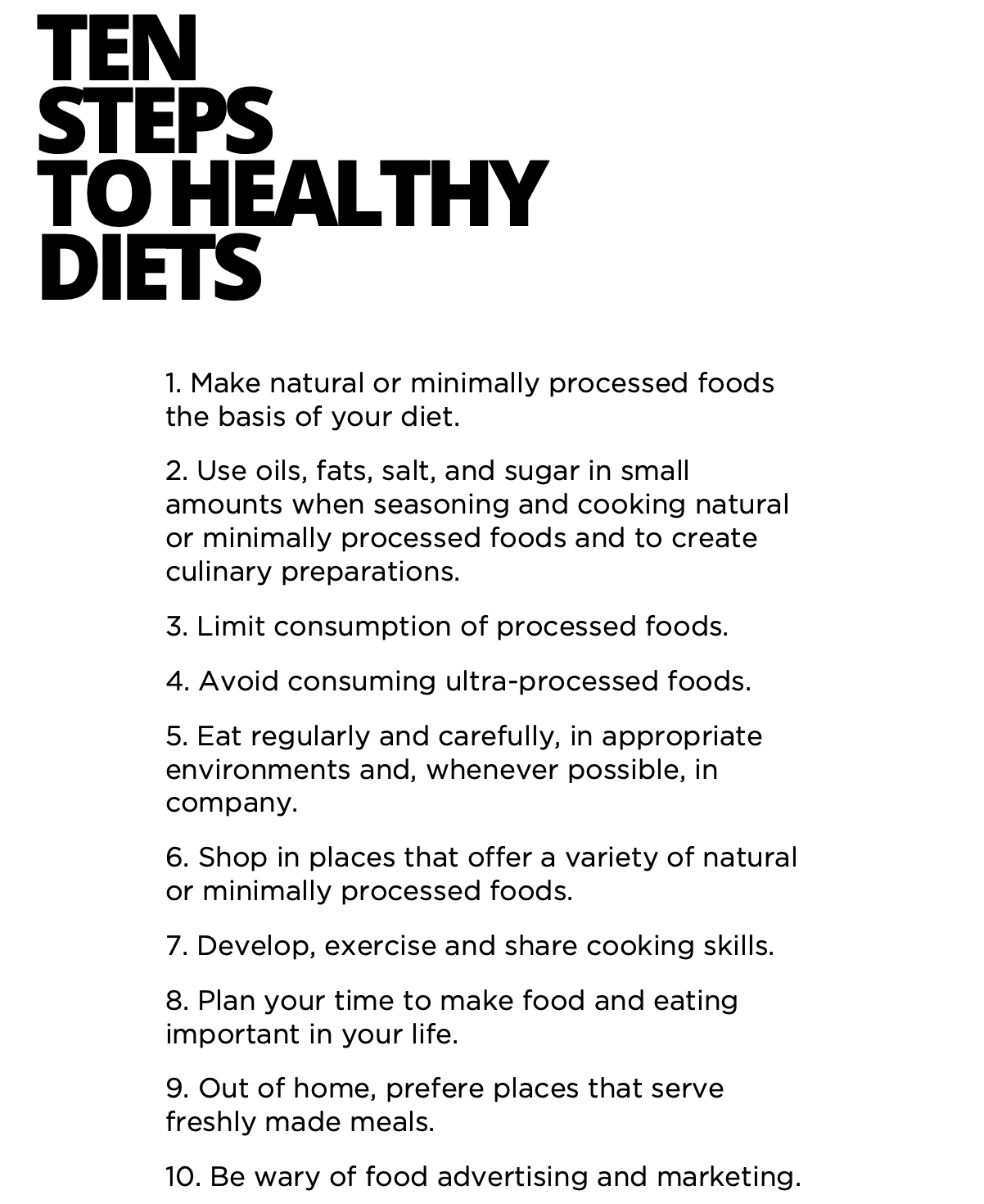
Brazil, has what is considered to be the best food guidelines in the world.
It’s not even a guide with a specific shape. It’s more of a vibe. Their guidelines go deep into the social aspects of eating and cooking together, by asking people to enjoy and endeavor to like the process of turning ingredients into dinner. The idea is to promote happiness and ritual and the social joys of being together, getting outdoors and physical together.
The focus isn’t beating a disease. It breaks food down into the amount they have been processed; natural/minimally processed, processed, and ultra-processed. This helps people undertsand what is good for them and what isn’t. ”Real Food” starts to become obvious. The message in Brazil is clear: Big Food companies are not valued above people.
If you read most food guidelines, they are about beating down obesity and diseases. Our guidelines do this as well. This makes eating feel punitive. Brazil wants their people to embrace cooking and eating as a lifetsyle change that is about personal and family fulfillment.
At the end of rhe day, what RFK probably doesn’t realize is that what people cook is almost always determined by their housing. If you live without air conditioning, have roaches and vermin, don’t have pots and pans in your weekly hotel, spend too much on rent and have no money left for groceries, these things determine what people practically can do in their kitchens.
What I hope is that Secretary of Agriculture, Brooke Rollins, can set aside her “thousands of meal simulations” and speak to real Americans about what is and isn’t possible economically at their dinner tables and kitchens. They don’t want to hear they can feed their kids three meals a day on $15 when the most SNAP pays for a single person per month is about $10 per day, with an average of $6 a day.
I hope RFK has a plan for how these new meat-heavy guidelines will roll out in school districts across the country. Will the federal government provide extra funding to revamp Las Vegas’ district kitchen now that they are no longer allowed to buy prepared foods (buritos, egg sandwiches, etc) from vendors and reheat them on site? Could this be the moment we get real food, homecooked in the 5th largest school district in the country? Will the federal government pay for kitchens in actual schools to be re-fitted for all kinds of cooking again? Will there be educational programs to help get kids on board with eating real food, taking their time, socializing over food, getting to cook it and feel connected to it? Will the federal government be paying for that?
Does “Eat Real Foods” apply to people in jail? Institutions? Who deserves real food? People who haven’t make mistakes? People who aren’t poor? Or just the upper classes who can easily afford to have their hired help throw a couple more steaks in the cart?
RFK didn’t invent something new here. You can get beef tallow at Walmart right next to the duck fat. And liberals buy whole milk, too. As a woman with ostepenia, a precursor to osteoporosis, I do eat more protein then I have in the past from a variety of sources. I cook with beef tallow, chicken and duck fat, pork lard, olive and avocado oils because they make food taste good. David drinks his protein shakes, but we limit the meats. Lentils rule.
This doesn’t feel unmanageable to me. But this diet recommendation isn’t for everyone and what we need from the director of HHS, is a common diet that can work for all Americans.

This is great! Thank you. Kim. I like seeing what other countries recommend for healthy diets and how our pyramid has flipped--great job with the visuals. I also appreciate how you highlighted the hyper-masculine aspects of our new guidelines, a reflection of RFK Jr., Hegseth, Trump, et al. As a vegetarian for 30 years, I'm always perplexed by Americans' obsession with meat as if it's the only source of protein. It is really not hard to get plenty of protein with a plant-based diet.
Thanks for that link to the connection between red meat and heart disease. I will be shifting my consumption as a result of reading it.