

On Reading.
And its Subtle, but Powerhouse Rebelliousness.

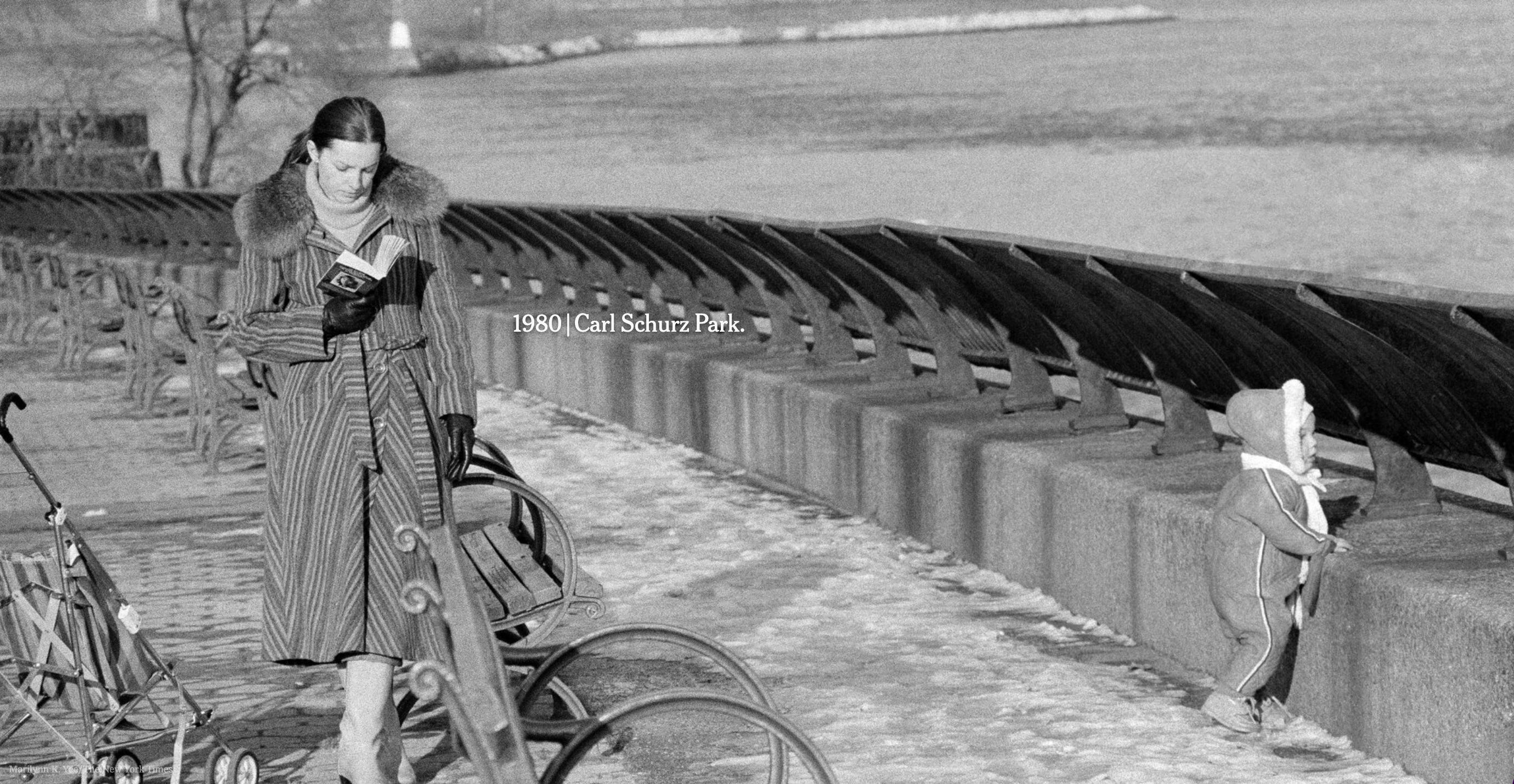
Edie, our 20-year-old, is home with us for a month before she leaves for a summer physics class at a university in England. I found her this morning, and every morning, curled into the couch, reading her favorite book. It’s a paper back, a dense, chunky thing, with tiny print. It’s dog-eared, well-read. She has this love for Walter Isaaacson and his biographies. She has re-read this particular book on Einstein: His Life and Universe about four times now. She has lugged this brick around the world. She has also read Benjamin Franklin: An American Life and Leonardo DaVinci.
When we moved to Vegas in 2014, I noticed a shift in how our children were educated. I don’t know if it’s largely about place or timing. Just that Lucy and Edie had attended a very progressive school in NYC called Central Park East II. Reading and writing were critical features of their education there, as was political protest (Occupy Wall Street, visits w/ Yoko Ono) and outdoor adventures (ice skating in Central Park.) That school fit us like a glove, and the friends we made there are still like extended family in our lives.
But in Las Vegas, I noticed a strange phenomenon. My kids were not reading books. Kids, in class, were asked to log onto computers, read a short article or essay, from the news or excerpted from longer work, and then given multiple choice questions about the piece they just read. The model is called HMH Into Reading / Into Literature, a program our Vegas school district uses as the core English Language Arts curriculum.
The view is that these targeted programs are better for language comprehension. They help kids figure out the “essential question” of a piece. The program supports kids whose first language is not English, by adding prompts in their first languages. The kids are able to read selections from a diverse array of titles, not just a few and ones chosen by a single teacher. And the student’s reading can be tracked.
The main purpose of this is to get better test scores. Not once, is any of this about finding your child curled up into a corner of the couch, devouring something that lights them on fire. Not once does a kid look up at you, turn her book over quietly in her lap, and say: This 73-year-old white dude is my favorite author ever and I can’t get enough.
I am not a luddite about most things. I don’t want to become the kind of person who gets too comfortable, who believes everything was better in the old days. I’m committed to embracing change and trying new things, bringing some friction into my life, and staying flexible and open. I am about the present and the future, while honoring, and reckoning with, the past.
This is the way forward with AI and all the impending changes we will face as we age. Adapt or die is the human condition, afterall.
But it’s hard to watch the obliteration of reading. The obliteration of the time for reading. The obliteration of the will to read. The obliteration of the habit. It’s also hard to watch the dismantling of the non-fiction writing world, because of the use of AI. In the lastest issue of New York Magazine, publishers are clearly struggling to fact check against AI, and authors are leaning too heavily on the tools, blurring the ideas of what is writing and who is the writer.
I feel like everyone is passing off AI work as their own and most of the time don’t say anything about it, said a senior nonfiction editor at a major publishing house in the New York Magazine piece.
Seeing Edie this morning, no devices, no sound, just the slant of morning light across her still body, and the quiet of a mostly sleeping house, reminded me of what we have lost. What I have lost. What I try to regain here by writing everything out by my own hand, like a writing luddite, a happy one.
In my early small town rural life, there were no bookstores. There was a newsroom with magazines and papers, and penny candy.
I read the books my mother read. I was never exposed to Judy Bloom’s books or any children’s books past board books. They probably would’ve seemed to tame anyway. None of what I read was age appropriate. I read every Stephen King I could, It, Pet Semetary, The Shining. I also loved horror writer, John Saul, whose book, Suffer The Children about a pissed off girl ghost who disappears children into a hole and watches them die, took over my mind for about a year. For years, I dreamed I would die in a hole surrounded by other smelly, decomposing bad kids.
There were the romance books, by Barbra Cartland. My next door neighbor, Julie, and I used to take the paperbacks out away from parents, and take turns reading racey passages to each other in the bwckyard swing. There were throbbing manhoods and pulsing mounds. Later, came the racey Palomino by Danielle Steele. Star came out around that time, too. All her books were like lessons in sophistication, wealth, romance, class consciousness and mobility, unbridled sex, at a time when all of this mattered culturally. It was the end of the 80’s and we were moving toward the Greed is Good 90’s, after all.
My mother’s small hallway shelf (she didn’t believe in keeping books) also had the book, Genie: A Psycholinguistic Study of a Modern-Day Wild Child (1977). Feral children held a special slot in the post-institutional zeitgeist of the late 70’s, early 80’s. People filled whole books with stories about how to care for feral children, and the miraculous workers who believed in them and nurtured them back into civilization.
I read my mother’s paperback of Alex Haley’s Roots. 900 pages of Kunta Kinte and his family across seven generations. Then the movie series came out on TV, I was not allowed to watch it. Like reading all 900 pages of a book detailing the horrors of what actual humans went through in enslavement at the hands of white overseers, wasn’t enough of a nightmare. I read Midnight Express after it was published in 1977, and later saw the movie in the theatre, about a college student who gets arrested in Istanbul for selling hash, and gets sent to a Turskish prison. I still am not able to visit Turkey.
My first feminist texts were not from Carol Gilligan or Bell Hooks. They were from Erma Bombeck. Her 1976, hilarious book, The Grass Is Always Greener Over the Septic Tank and her 1978 If Life Is a Bowl of Cherries, What Am I Doing in the Pits? made me think I could write funny things, and that writing funny things could matter and be transgressive and transcendant.
When I think about reading and what it meant to me as a young person, it was that it felt like a rebellion. I’m not using that word lightly. Like someone blurting out an empty: Joy is an act of rebellion! I mean it literally. Reading back then wasn’t this obligation or thing we should do. When no one was watching, we made sense of the complicated world we couldn’t Google for answers.
The dark, terrifying stories helped make reality so much easier. And yet, there were so many things to fear. In the 80’s, our culture moved to hyper-consumerism, a rise of mall culture, suburbs of isolated utopias, that sheltered and protected some people, while excluding others. Our parents tried to be upwardly mobile. They chased affluence and markers of affluence. Moms and dads both worked, and had their own lives away from our houses, as we did away from them.
Rudimentary computers made early appearances, divorce ticked up and our families separated, grown kids started moving further away from families for college and their own careers, upward mobility felt like the only goal. AIDs was inexplicably killing people and we knew one episode of real sex could end our lives. Russia and the US were locked in a nuclear death grip that threatened to emusify us.
No matter what was happening in the real world though, there were always girls at prom drenched in pigs blood, vengeful girl ghosts, hot untouchable characters screwing and sucking, hotel caretakers devolving into psychosis, and people at risk of being tortured unjustly in foreign prisons. The extremes were comforting in the same way violent true-crime stories can comfort us today. At least, we haven’t been cut into pieces and left in the woods to be discovered by a dedicated cold case detective who will never quit the search for my decaying body.
At least, we aren’t trapped in an attic, for literal years, by our psychotic mother….
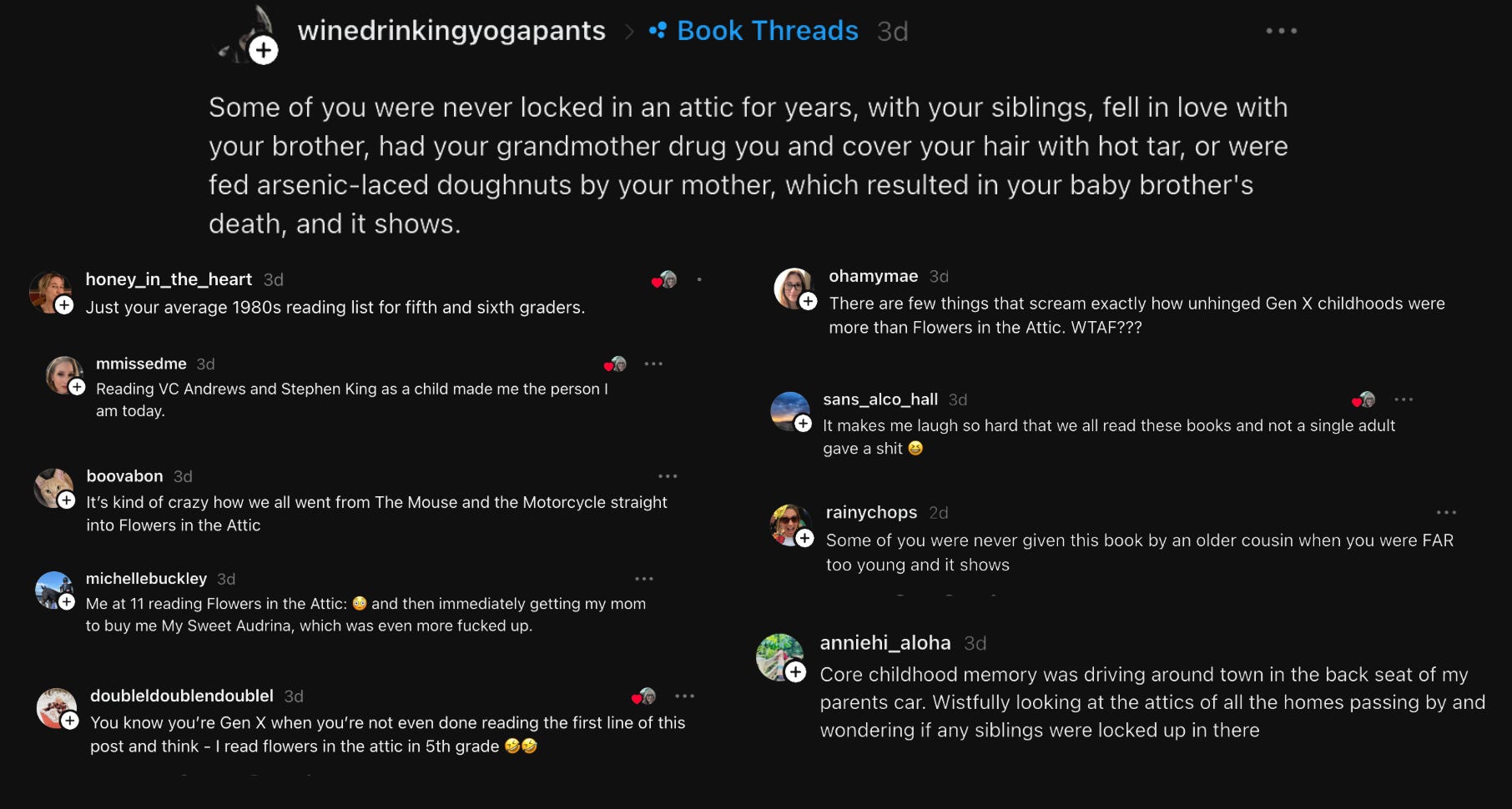
I started thinking about this when I noticed my fellow GenXers on Threads talking about what the book, Flowers In the Attic, did to our collective young selves.
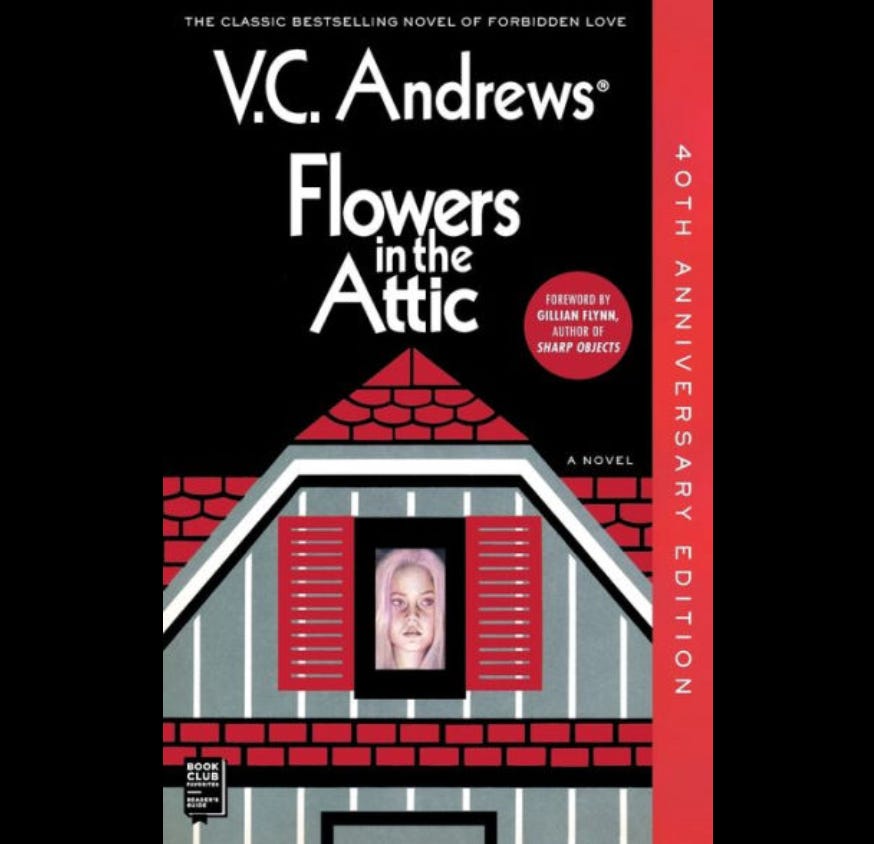
The book, published in 1979, by VC Andrews, seemed to define us as young people in the 80’s. The plot is remarkable. About four siblings who are forced to live in their grandmother’s attic by their abusive religous zealot mother, who intermittently beats them with a cane. She explains their confinement by saying she is keeping them hidden to collect a family inhertitance that requires her to not have children. She says it will only be for a few months. But the kids are kept in the attic for years, moldering in isolation, starvation, boredom, and psychological regression.
A couple of the siblings fall in love with each other and there is some very hot sibling romance, longing, jealousy and sex. Eventually, the kids are given arsenic donuts by mom, in an attempt to get rid of them once and for all. One of the siblings dies from the poison donut, reframing what something as simple as a donut could mean for our mortality.
Weirdly, the book, which was supposed to be adult fiction, felt elemental to kids, while the culture underwent all kinds of societal havoc. Phil Donohue and Oprah put families on display on their afternoon TV shows, and much to my mother’s horror, blamed mothers for eveything! In fact, all of Flowers in the Attic is a critique of misguided, overbearing, narcisstic mothers, who were motivated by consumerism and wealth-building, and not so much the focus on their children. It’s also highly autobiographical, as the author Virginia (VC) Andrews, had a coercive relationship with her own mother, who cared little for her writing, criticisized her mercilessly, but also forcibly accompanied her on all her book tours, sitting next to her at the signing table. Their relationship was deeply complex and inter-dependent in some ugly ways that came out in her writing.
The novel and its sequels also recognized a deep and abiding fear that has shaped women of my generation, writes Tammy Oler in a 2014 article for Slate, the fear of turning into our mothers. As Cathy’s love and adoration of her mother, Corrine, turns into bitterness and anger in Flowers in the Attic, she becomes determined to get free of her family and be nothing like her mother. Yet through the decades that span the novels that follow, Cathy finds herself becoming more and more like Corrine.
The daughter, now a mother, sets up her children’s beds, in neat rows in her own attic, not once questioning her role in repeating this generational legacy, or that she even was part of one. The daughter fulfills the ultimate horror, and turns into her mother. It is the ultimate nightmare for GenX youth: Our childhoods rebelled against confinement. We had childhoods of escape. The freedom was the point. It was the focal point of our rebellion.
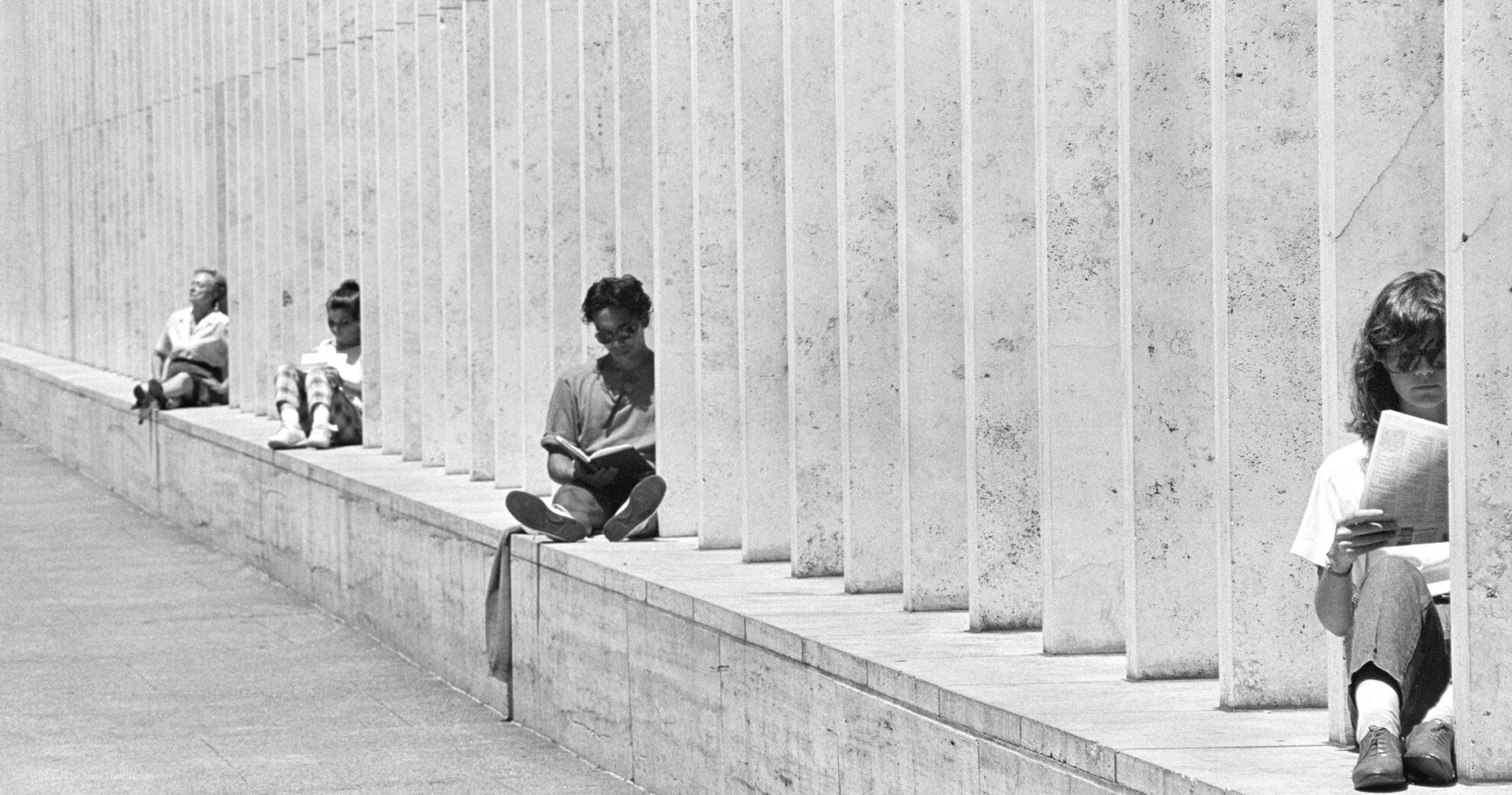
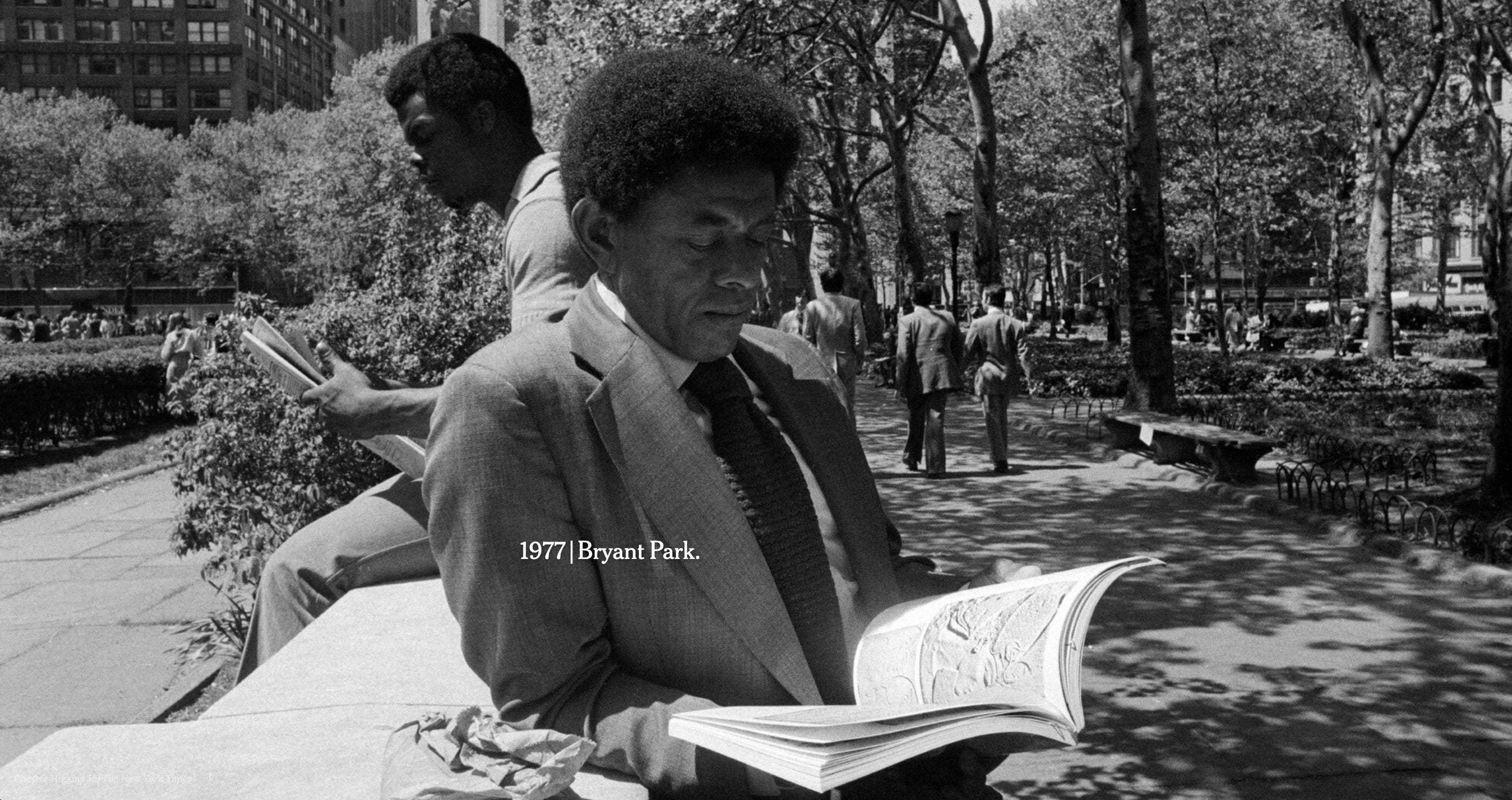
Years ago, the Freakonomics guys taught us a lesson in correlation and causality. They said that buying a bunch of books and putting them in a child’s room wouldn’t magically make them better readers, but when the house the child grows up in is filled with books, there is a better chance that reading matters to the household, and that these values will get passed to everyone. Our little house in Vegas is filled, stuffed even, with physical books. We have a Little Free Library in the front yard. Books are, for whatever reason or simply by luck, catching on with our kids in young adulthood.
Did our book shelves move the needle? Or our love of reading? Are they readers despite us? We won’t ever know for sure.
I’ve struggled to love audio books, the reader’s voice matters to me in weirdly picky ways. I’ve embraced the Kindle, particularly at night when David needs a completely dark house to sleep. I use physical books for research, mostly because I write in the margins. I remember where to find particular data, by remembering what I wrote in the margins. I haven’t been able to replicate that experience on the Kindle. Yet.
There are so many things I want to read these days, even as I find myself needing to carve out time, and be intentional about making it happen, even when sometimes I’d rather scroll and sink into a kind of oblivion. I’m off a lot of social media now. Mostly, because I’m over the lie that authors have to have gigantic social media footprints to sell books. Scrolling is a hot fudge sundae at midnight. We might deserve the mindless treacle for all our hard adulting, but it’s not going to feel good after. I want to feel good during and after, like I’m engaged in a quiet act of extreme defiance.
The rebellion of reading is being swept away, fully and completely, by the story. Lost in it. So lost it hangs over you for hours and days and clouds your mood, surfaces in dreams and in thoughts in the shower. It’s rebellion against the AI we didn’t ask for. The wars we didn’t ask for. The prison camps and data centers we didn’t ask for. The precarious economy we didn’t ask for. The political divides and estrangement of our families we didn’t ask for. The tech companies that game the systems to suck up our time and turn us into vapid, programmed, obeying, flesh bags. The oligarchs and billionaires who want to build their affluence on the backs of the working class. The elites who keep people poor and on the edge.
I want to defy it all through the simple act of picking up a book, and losing myself in the author’s world that is not written by a chat bot.
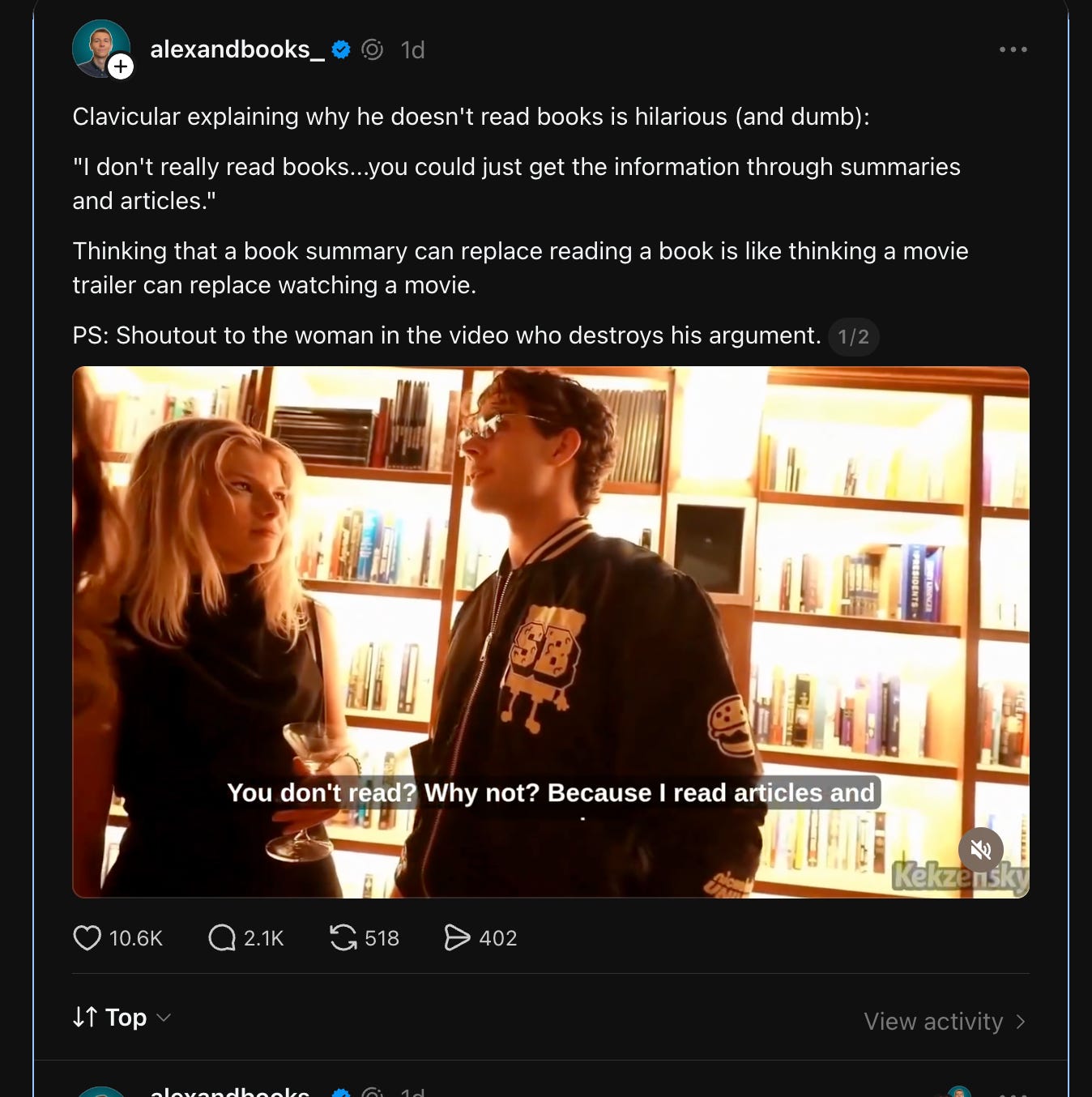
Because - and please mention this to Clavicular - the ROI on reading is prodigous.
Thank you, as always, for reading. xo Kim
END NOTES:
_____________
Thanks to everyone who heard the call for support and contributed to last week’s GoFundMe for my foster daughter’s family. They’re so appreciative. We are nearly at our goal and I will close it out and meet them at their new apartment to get them set for a few months. I’ll keep you posted from time to time on how they are doing. Thank you for keeping them in your thoughts, restacking, contributing and getting the word out. This community is the best. Thank you.
One more thing: I want to introduce you all to one of those awesome friends from Central Park East II in NYC. Kate Chaston is a voice-over actor / audio book narrator and singer, and she is going to be adding her voice to my essays. If you don’t have the time, ability or head space to read, you can listen! I post on Thursdays, so Kate will be posting the audio versions on Fridays. Let’s all welcome Kate to the community!

Oh my gosh! Sooooo many things. First, Midnight Express was so iconic to me and yep, it was my act of rebellion. I mean -- drugs in a book?!? It was so exciting for me and it was TRUE. I still have my sad copies of both Erma Bombeck's books. She began my love of essay-like books. Like yours! I only read Non-Fiction now. I haven't read fiction since I graduated college. I don't know why, I just prefer not to. But I have reference points for certain movies etc....
My grandson goes to online school. I am his learning coach as well as his online teachers. They have 40 schools in 30 states and then hundred's globally. He has dyslexia and ADHD. But, as with his mother, I insist he have summer reading. Every summer I choose a certain number of books with a certain number of pages to be read per day then, he has to come give me a verbal report of the pages he's read. This has been going on since Kindergarten.
At age 14, his summer reading is The Iliad first and after that The Odyssey. What I have been aiming for has finally happened. Three days ago he was talking about his assigned reading that day and he mentioned that it was reminiscent of some Anime TV show he was watching. He was very proud of that because I'm always talking about my favorite shows and how generally each one (Sons of Anarchy, Peaky Blinders, etc...) is some version of Hamlet.
Now, he's looking for clues in all the classics I insist he read in shows and video games he likes. I doubt he ever loves reading because it IS rather difficult for him, but he will at least have reference points of being a well read student. Reading is very important!
As always -- loved the essay!!
As always, thought provoking and insightful. As a proud 26 year public school educator, I can assure you we are failing Vegas children and their possible joy of reading for pleasure. Unequivocally, totally and completely. We are failing to teach comprehension while reading long form writing. I suspect even that progressive NYC school is as well. It is a national push to teach reading differently and I do not agree with the premise. Watching the results, is quite frankly grotesque.