

Composition / Decomposition.
Pilates + the older body.

Last year in October, I fell. It was remarkably stupid.
I was meandering around the Las Vegas Book Festival with my canvas book tote, event map, and a credit card poised to buy a pile of new books. I was excited to see friends and authors speaking about their books. I went to one of the food trucks selling birria, and bought myself an ice cold Diet Coke. I was ready. A full day of book talk, seeing people I haven’t seen in ages, checking out what colleagues are working on, I was in my element.
I popped open the can, ready to take that first crispy sip (if you know, you know) when I caught my toe on the small, ankle-sized cement barrier that sits at the end of parking spaces to keep you from rolling ahead. Whatever brain mechanism was supposed to unconsciously force my hands out to catch my fall, failed. My hands clutched the Diet Coke. I slammed into the pavement. My head, right side forehead, hit the pavement hard enough that it bounced back. I didn’t lose consciousness, but I was woozy. More so than I tried to show.
It was, of course, a crowded area, where lots of people saw me fall. To the extent that a whisper campaign of people were talking about it, and passing on news of my well-being. These updates were being transmitted across the festival. I fielded questions about my health and well-being for the rest of the day.
The organizer of the festival, Brian, came over to help me up and dust me off, and everyone got me water and cold packs. Brian was also probably trying to stave off a lawsuit for the city, LOL, but he was kind. People love to help, and I had a lot of lovely people gathered around me. Which made it much much worse. I was mortified.
This intensified when one of the nice people reminded me that an 80-year-old had also been taken out earlier by these same parking structures.
“You aren’t the only one,” a bystander told me, trying to help.
The 80-year-old had to be taken to the emergency room. I was in my 50s, strapping compared to many 80-year-olds. Sure, I was old compared to teenagers, but I was young-old, compared to 90-year-olds. A veritable spring chicken, a baby even, in the senior world. And yet, my body was changing. I couldn’t deny it. Getting up and down from a kneeling position in the garden was harder, and required grunting to make it happen, and sometimes a lift under the arm pits from David. My body was saying something and I wanted to LaLaLaLaLaLaLa with my hands over my ears.
Some of my wobbliness was the after-effects of having had a brain tumor - both my balance and my hearing are legitimately compromised - but when you are younger, being mostly deaf and unable to ride a bicycle seem like funny quirks, part of life’s interesting scars. Telling people at parties how you fall over in the dark because you no longer have one of your balance nerves promotes lively conversation, it’s funny storytelling.
It says: I am a person with stories and history. I’m interesting. But falling and being deaf are also signifiers of aging, of obsolescence, of invisibility, of disability, of isolation, of frailty.
And I hated it.
David is dedicated to his health. You all know this. For the newer subscribers, this happened after his heart attack in 2020. It scared him enough for us to make multiple changes in our health and habits, and to priortize disease prevention as best we could. David spends hours researching, has a dedicated exercise workout, saunas daily, eats a specific diet, uses supplements and makes himself protein shakes. He has pills and powders, like he works in a lab. He looks great. Hotter than when I married him, and definitely healthier.
He is in LA right now. I noticed that he packed the Vitamix in the car when he went. There will be protein shakes in the hotel room! And last night he was at The Magic Castle with colleagues, and he reported in a late night text, that he ate the salmon for dinner (healthy) didn’t have alcohol (healthy), but that the dinner was later than he usually preferred (could be earlier). His Woop strap was not happy.
But despite the focus on our health, I’ve struggled with an exercise regime. I’ve gone through periods where I‘ve intensely exercised - Orange Theory, local gyms, Cross Fit, Jane Fonda on cassette tape in my dorm room, single woman in her NYC apartment’s weight room, running the resevoir in Central Park, walking our newborn, Lucy, through The Gates post-partum in Central Park.
I have been stuck on this idea that leading an active life was better than going to a gym, because once, years ago, I had seen a rom-com, starring Jacklyn Smith, where she gave up her high-powered city career for a small town fisherman, and with it, the stairmaster. She traded the artifical for the real. Jacklyn would exercise by being in the world. So would I.
This never happened, of course.
I was waiting to fall in love with exercise, and for the last year or so, after the book festival fall, I had hoped something would click. His mother had been largely inactive, riddled with osteoporosis, and so he had this fear I’d follow behind her. She died after a long hospital stay where her bones had become so brittle and hollowed out by disease, they were unable to support her body. My recent diagnosis of osteopenia didn’t do much to make either of us feel better about it.
When Edie came home from her summer physics program in England, she was looking to make a routine here in Vegas. A highschool friend was teaching Pilates out in the burbs. She started going.
Pilates is sometimes a $75 a drop-in class in New York City, where she is going to college, so this was her chance to try it for free. She is doing Hot Pilates, Booty Pilates, Bootcamp Pilates, Reformer, Mat, everything on offer, multiple times a week. She started hounding me to go with her.
Don’t you want to live to see your grandchildren?
Ugh. The guilt. Fine. Fine. But I wasn’t going to drive out to the burbs for the fancy class. I researched.. Read about Pilates. Read the scholarship. I went to a class five minutes from our home.
Pilates, turns out, is not without its controversies and incumbent toxicities.
Pilates is a kind of Gen Z obsession. It isn’t just exercise, it’s a lifestyle. A way to be seen. It’s how you show yourself on IG and TikTok. It signifies money, and that you have control over your body, in a time where young people often have to move back to their parent’s houses to afford actual living. We seek control in places where we can.
It is expensive to go to Pilates, bougie even. Memberships can be as much as $400 a month for all-in memberships. Pilates has its own fashion in the form of pricey LuluLemon active wear (some leggings go for $130) and special grippy Pilates socks ($25). The body you get doing Pilates is toned and straight. It is the exercise for people who take GLP-1s, who want their collar bones to show and who care about the size of their thigh gap.
Gone are the Karadashian curves and the Brazilian Butt Lifts. It is no wonder that Kim Kardashian herself has slimmed down, and also created a shapewear line called Skims, that is supposed to streamline and pull you in. A girdle, essentially. The motto of Skims is: Solutions for Every Body, like we need solutions. But apparently we do. Her company made over a billion dollars in profits last year.
Pilates has its own signifiers. The Pilates Princess is its archetype. She is not flipping truck tires at Cross Fit. She is softer, feminine, her muscles are lean and strong, but not hyper-defined. There is no masculine, it is long lines and lean muscle, strong at the core, but refined. It’s not girl boss autonomy, it’s not smash the patriarchy. There is a whiff of trad wife here, but it’s not quite that either. The Pilates body is no different than all the other beauty tropes we’ve lived through. Thinness is still the desired body.
It’s essentially where control, discipline and pristineness are prioritised, Dr Kat Schneider, a research fellow studying changing body image trends at University of West, England’s Centre for Appearance Research said, in an article for The Independent. This “pilates body” aligns with this cultural narrative of restraint, minimalism and wellness.
But Schneider also points out that that Pilates itself is a cousin to what Jane Fonda created back in the 80’s. And this is what stayed with me when I took the Pilates class with Edie. It reminded me of leg warmers and Jane Fonda and leg lifts on the floor of my dorm. And because of that, the class we took, felt immenently do-able. I had done this workout before, while it still felt incredibly novel. Even things I hadn’t thought I could do, like balancing on one hand, with the opposite leg in the air were exercises that I was gently nudged into trying, a supportive instructor guiding me, positioning and re-positioning my body, checking my breathing, only to see success. It was kind of intoxicating.
The class time flashed by. I walked out feeling great. And, weirdly, I kept finding reasons to go back.
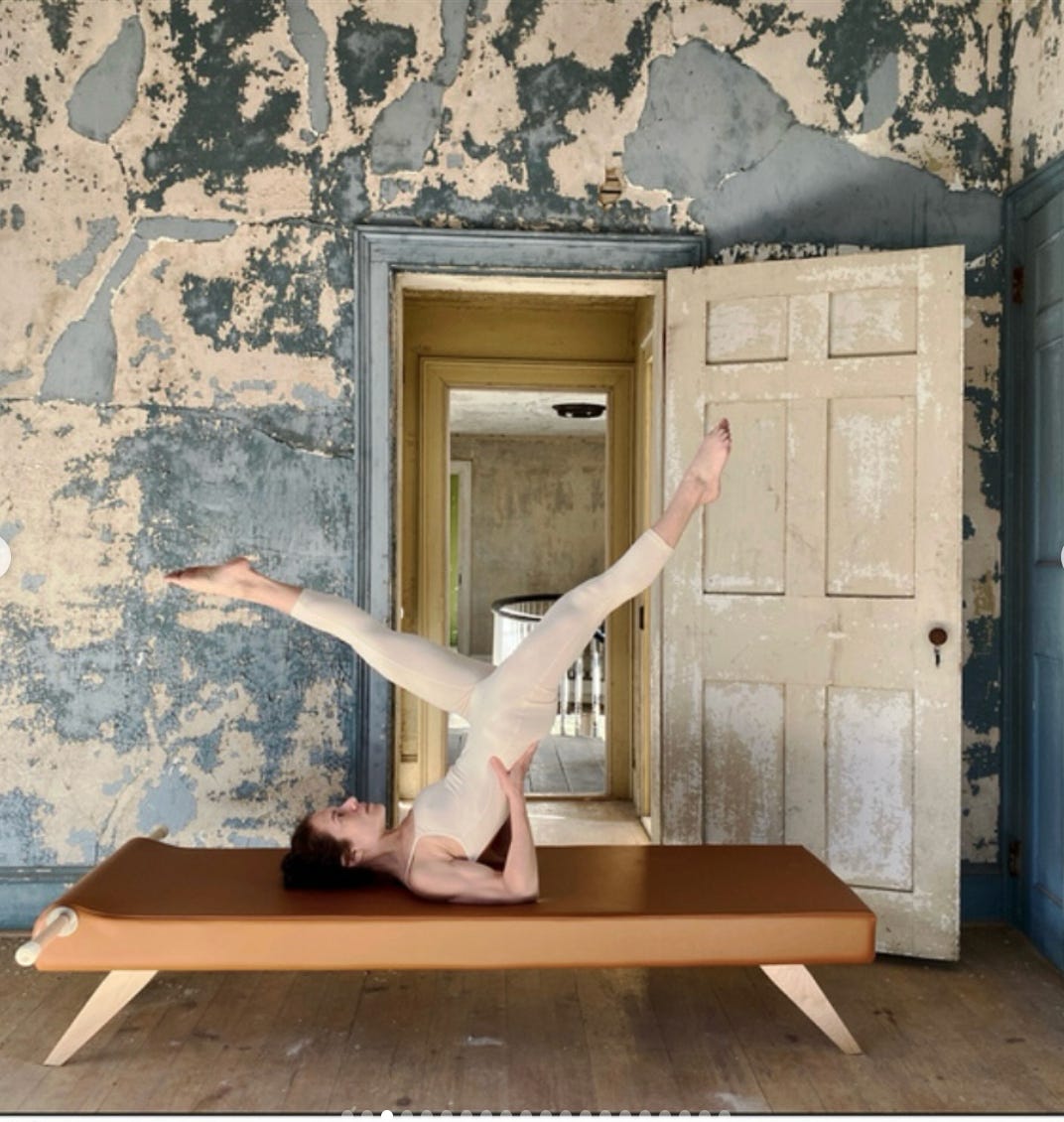
I might’ve steered away from Pilates, in a former life, an act of exercise so interconnected to money and control and the cultural zetigeist that I woud’ve not been attracted. I’m not a herd-joiner, I like to tell myself. But managing the aging body has shifted much of my thinking. As I told my dear friend, Alisha: There is something about exercising while laying down that will always appeal to me.
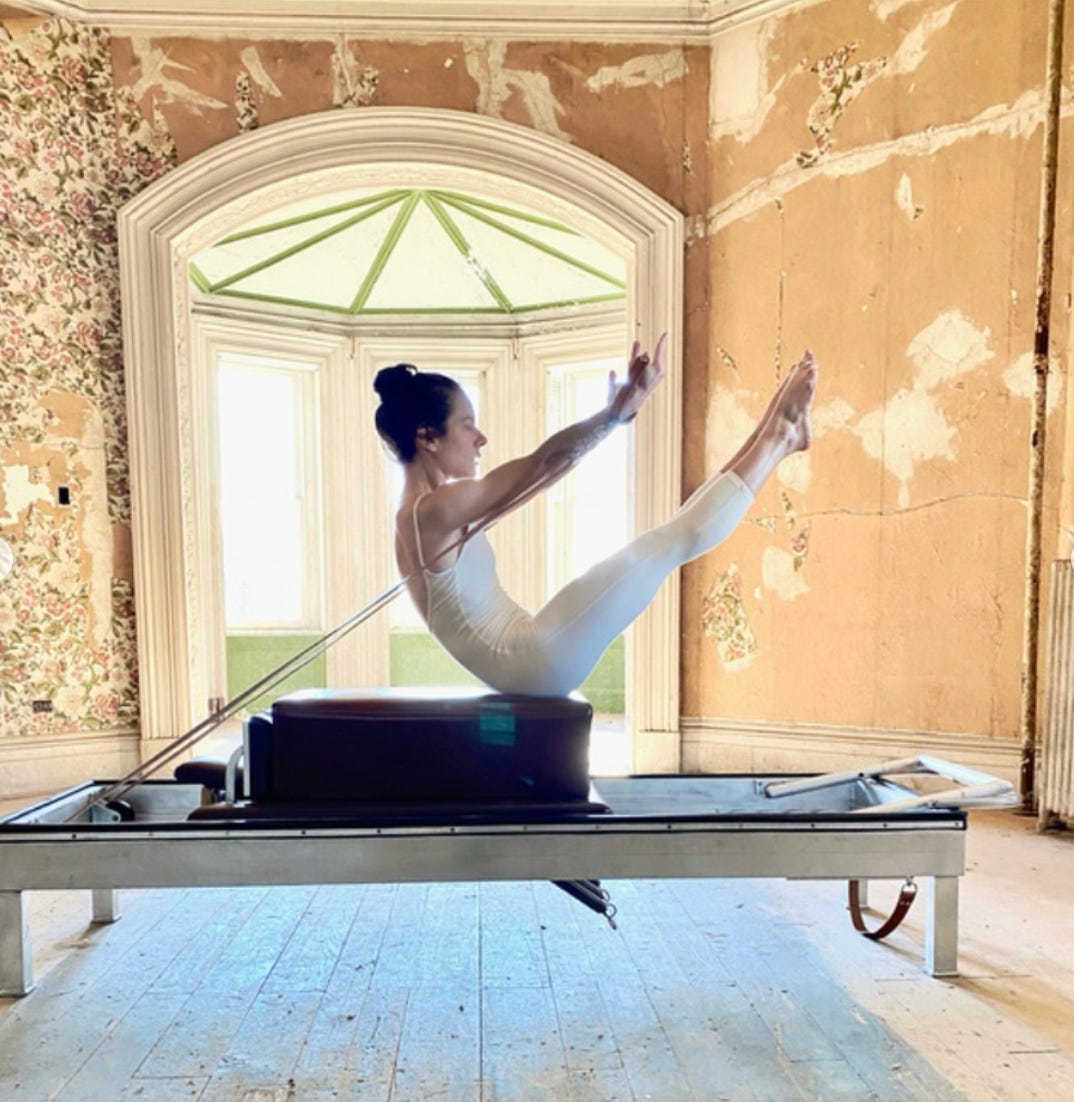
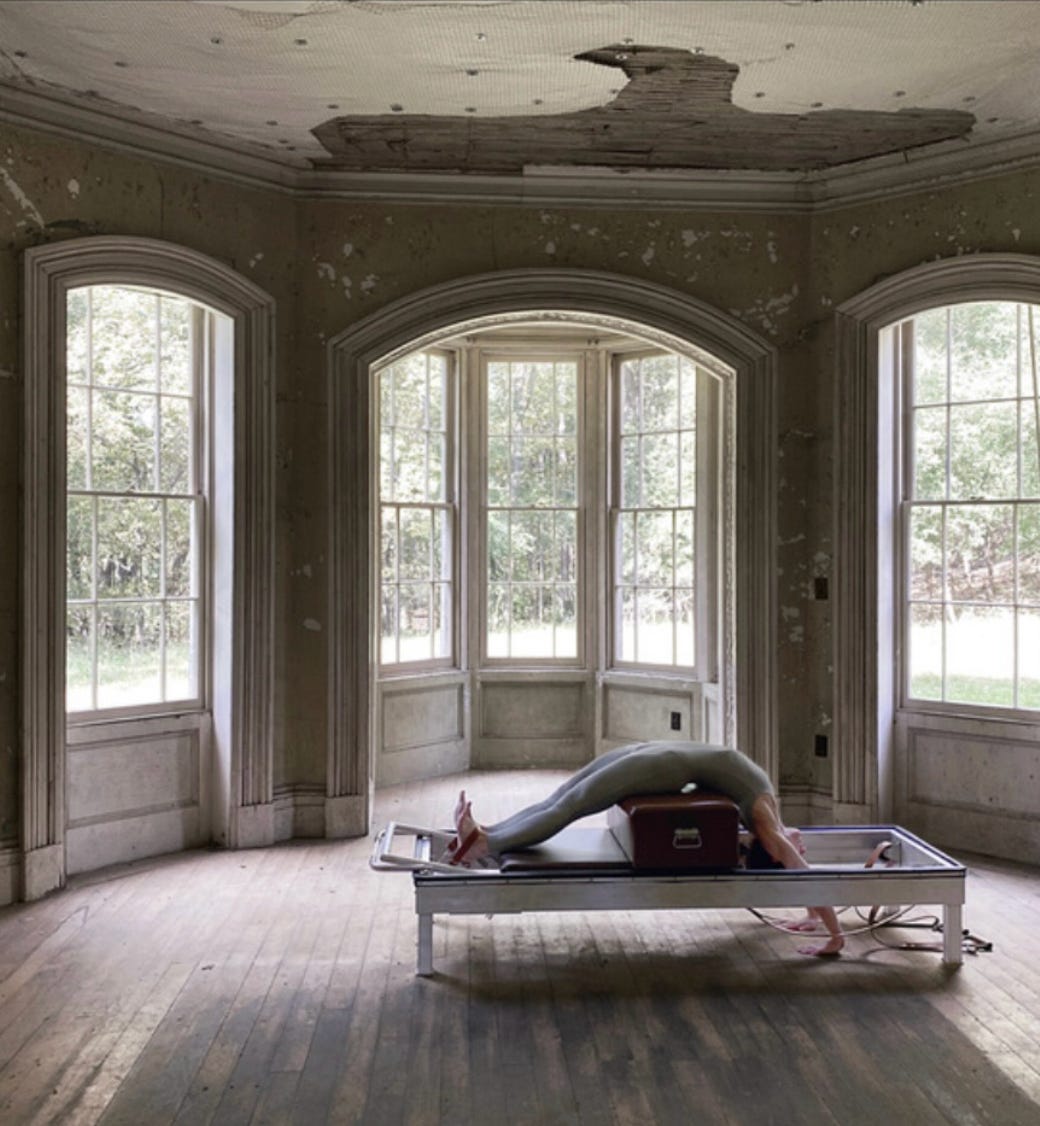
Pilates is slow, balanced and smooth movement with resistance, that is done on a this slab called a Reformer. The Reformer looks complicated to use, lots of pulleys and springs and straps. Add a tray of filleting knives, hang some plastic sheeting, and it’s a scene from Dexter. I was intimidated.
But I kept going back. At first, I made it about time with Edie, but then I started going without her. No one was more shocked than me.
My teacher, in our first session, was able to see that balance was a big issue of mine simply by watching me move. The work she did, just on the balance aspects, the breathing, the focus on pulling in to the core, made me feel more stable. More firmly on the ground. My balance will get better and better, and this will help with the clumsy falls, the face-first public humiliations, the very real repercussions of what falling can mean in older people as I age.
The classes I’ve attended - admittedly I’m just starting out on this journey - have been a kind of balm against exercise that feels like it is beating up my body. I will never forget taking a Cross Fit class where they put us on teams. Losing team had to do some grueling exercise as punisment for being the losers. Part of the competition was doing 20 box jumps. I remember my team screaming at me to complete the 20 box jumps. I was the only one who couldn’t do it. My knees were not having it. I cried. I never went back.
Pilates is the antidote to that. It is an antidote to the proteinmaxxing, supplements and testosterone-driven masculinity that has dominated wellness. Where truck tires and kettle bells feel like an assault on my post-menopausal joints, where the pounding club music of Zumba makes me feel ovewhelmed, where the local gym smells like toe jam and chlorine, Pilates is gentler and kinder. A moving meditation of small movements and invisibly-measured out control. It wants me to feel calm and strong. It opens up the closed off pockets. It wants me to stay upright.
It wants me to feel the ground. And stay there.
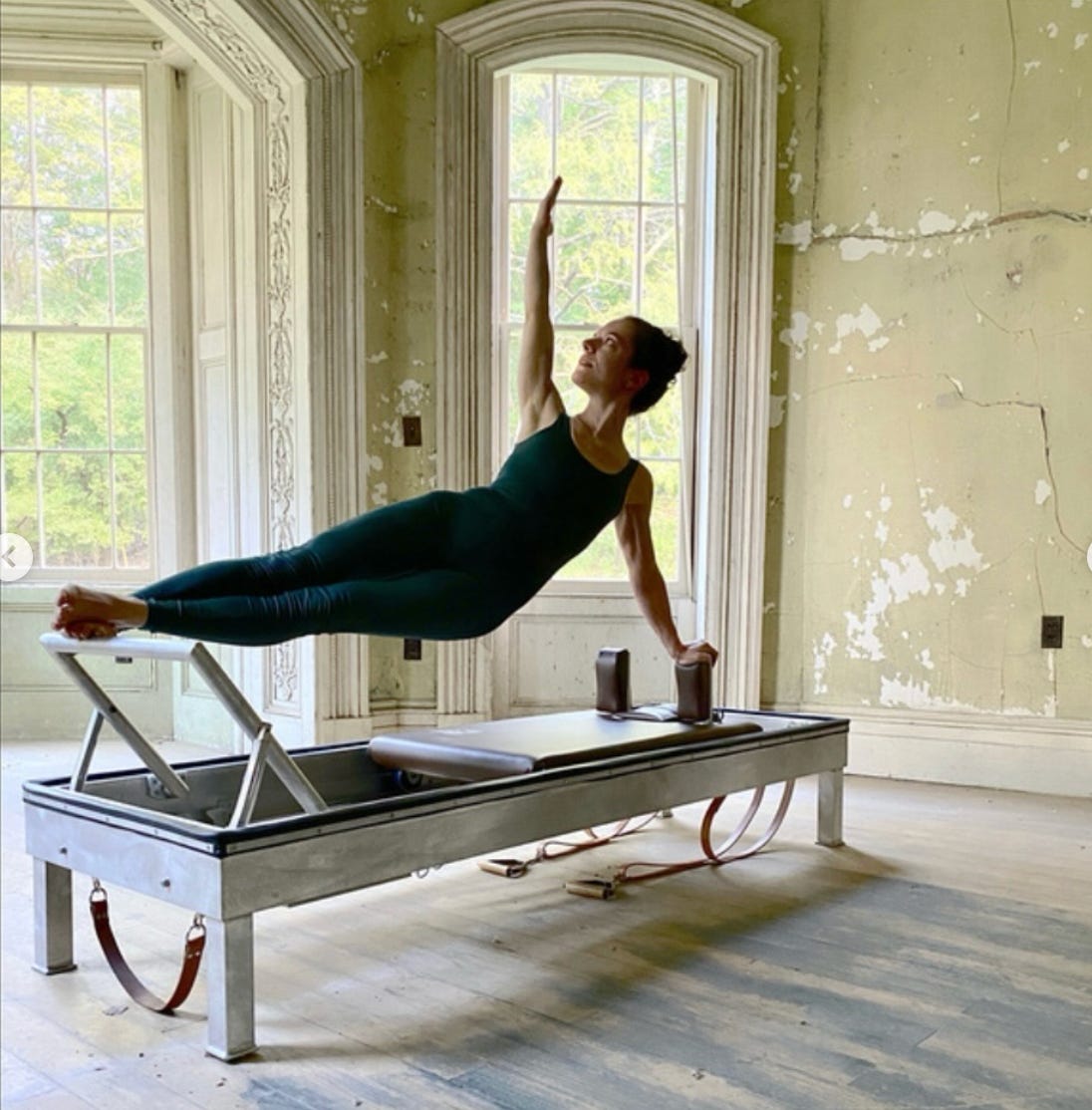
Being in an aging body, I think, nullifies many of the toxic aspects of Pilates performance culture.
As a 60-year-old I’m not going to be subsumed by new forms of beauty propaganda in the same way young people might. I’m not interested in getting a million followers by performing an affluent version of myself. I’m cool without the fancy grippy socks! This is THE UPSIDE to getting older.
The studio I go to has a generous senior citizen membership that comes out at about $6.25 a class. Pilates has a reputation for skewing white and affluent on social media, but in the classes, the demographics reflect our neighborhood, white, Black, Filipino, and Latin American. We are light on young men, but not older men. I’ve met several lovely women my age, and a decade or two older. This rings true with Pilates professionals:
If you go into a long-standing studio such as mine, it is a mix of all ages, sizes, abilities, races, genders, everything, says Laura Thornton, pilates practitioner and owner of the Form and Flow studios in England. It seems that social media has projected this idea of wealth and affluence, and it being exclusive to very thin, able-bodied, slim people. And that’s not a real representation of the real classes.
She goes on to talk about why a Pilates practice works so well for imperfect bodies:
In our training, we’re taught that this exercise is about moving your body this way for aligning this way, for working on mobility or stability, she says. We’re not really trained to change your body in terms of size and aesthetically in real life. In the studio, we work with a lot of people who have kind of common injuries like bulging discs, knee replacements, knee surgeries, rehab, things like that.
It was never about beauty, the color of your Stanley Cup, or aesthetics anyway.
A 2022 study about Pilates and it’s impact on older bodies shows a lot of promising benefits, including strengthening the core and posture, alleviating back pain, improving balance and adjusting body positioning to prevent falls, increasing bone density, slowing down degeneration of the body and muscle wasting, and punching up the immune system. Even doing Pilates on the floor, in your house with a Youtube video, the study says, provides a lot of the benefits you can get in the studio. Although the authors do mention that going to a studio with other people increases connections to other humans, and improves social connection which also can stave off cognitive decline. The effects on mental health, being out of the house, interacting, laughing, moving and being super-intentional in thoughts and movements can support good mental health.
Pilates is about aiding the long haul of the body, it’s weaknesses, sicknesses and deficits. It is built for older bodies, for imperfect bodies, for struggling bodies, for bodies like mine. And I really really do not hate it. And this is perhaps the biggest wonder of all of it.
I got an email from Brian of the Book Festval last week.
He asked me to moderate a panel at this year’s book festival about growing older and being an artist. The talk would be with three artists who have written books about how aging and art have intersected for them. I said yes. We emailed back and forth. Brian concluded his email this way: …and I swear we will make sure to cover the parking blocks in the right-of-way this year!
Bless his heart.
Thank you, as always, for reading and supporting. Kim xo
____________
END NOTE: For inspiration, check out 72-year-old Chef Rick Bayless doing his Pilates practice. You will notice he says he has a new “routine.” I want to have a routine!!! #Goals. LOL.

You know, Kim, I support just about any exercise (I was never an athlete, so I am more like the zealous religious convert) and think Pilates is good - and yoga better for me, but it's not an argument. What you may not know is that I fell a week ago, slipped on a low step and found myself on the ground, but was not hurt much at all. I limped to the bus to get home, but with ice etc, I had no limp the next day. I still don't know if my lack of after effects is because of my yoga (I wrote a very viral Note the next day asking this question and a lot of people think it was), but at 84, it certainly helps me keep active. Keep it up. And don't think of yourself as old – you're not even on the foothills!
I am fortunate in that at age 78, my bone density is normal despite being estrogen deprived since menopause. My mother lived to 95 and never had a fracture. What I am seeing from the menopause experts, though, is that what builds bone, in addition to systemic estrogen, which you have said you are on, is lifting heavy and the impact of jumping from 8" minimum elevation to the ground, and consuming sufficient amounts of protein; that cardio and stretching are beneficial but do not specifically build bone. I'm glad to see that my 36 year-old daughter has embraced wieghtlifting and is the opposite of the willowy, skinny girl she longed to be when she was a teenager. At 6' tall, she is an Amazon warrioress, with powerful shoulders and thighs, who lifts grocery bags and her toddler daughter with ease.
I am on a different trajectory, unfortunately. Despite normal bone density, my joints and connective tissue are fallling apart, due to arthritis caused by longstanding estrogen deprivation. The only exercise I am able to do is range of motion and stretching in a swimming pool, and even that is off limits for me for a while, because I just had shoulder replacement surgery a week ago: my fourth joint that's been replaced. To younger women who still have the potential to intervene in their aging trajectories, I say take systemic HRT, lift weights, stress your bones, stretch your ligaments, eat protein. Stay strong. And don't worry what the number says on your scale or on the clothing rack at Nordstrom's.